.webp "tpu reactant ratio control with liquid metering pumps in tpu reactive extrusion lines")
In TPU reactive extrusion, consistent polymer quality starts before the melt reaches the screw. Isocyanates, polyols and chain extenders must enter the process at controlled rates, so liquid metering pumps are part of the reaction-control system rather than simple transfer pumps. For a complete process view, see JWELL's TPU polymerization reactive extrusion machine, which combines upstream material handling with twin-screw reaction and downstream pellet processing.
TPU is formed by reacting isocyanate groups with hydroxyl-containing components. The key relationship is often expressed through the NCO/OH ratio: the equivalents of NCO supplied divided by the total reactive OH equivalents. The required value depends on the specific TPU formulation, so a fixed pump-speed ratio cannot be assumed to represent the correct chemical ratio.
A 1:1 pump-speed ratio, for example, is not automatically a 1:1 chemical-equivalent ratio. Pump displacement, reactant density, equivalent weight, active-group concentration, temperature and actual volumetric efficiency all affect how much reactive material reaches the extruder.
.webp "why reactant ratio control matters")
A practical control sequence starts with the formulation and converts it into required mass flow. Engineers first determine the target equivalents of each reactant, calculate the required kilograms per hour, and then convert mass flow into volumetric flow when necessary using density at the operating temperature. Only after that should the pump speed or stroke be calculated.
The preferred sequence is: chemical formulation -> target mass flow -> calibrated pump delivery -> pump command -> actual-flow verification.
Positive-displacement pumps may have a theoretical volume per revolution, but actual delivery can change with viscosity, inlet conditions, discharge pressure, internal slip and wear. For that reason, the relationship between RPM and real flow should be established by calibration, tank-weight checks or an inline flow-measurement method.
The control system should compare the target ratio with actual material delivery, especially during start-up, throughput changes and long production runs. If one reactant reaches stable flow before the others, the material entering the reaction zone can temporarily move away from the intended formulation.
Temperature stability is closely linked to dosing repeatability because many reactive liquids change viscosity with temperature. Heated tanks, lines or metering sections may be used when the material requires controlled thermal conditions. Published TPU reactive-extrusion research has also described reactive materials maintained at temperature and supplied through a heated metering pump; see this open-access TPU reactive extrusion study for process background.
Moisture control is equally important. Isocyanates can react with water, so moisture can alter the effective chemistry even if the displayed pump rates are correct. Stable dosing therefore depends on both accurate pump control and properly conditioned raw materials.
Correct dosing does not guarantee correct TPU by itself. After the reactants enter the machine, screw configuration, mixing intensity, temperature profile, residence time and throughput influence the reaction. The dosing section and the JWELL twin screw extruder should therefore be evaluated as one process rather than as unrelated pieces of equipment.
.webp "integrating metering with the twin-screw reaction zone")
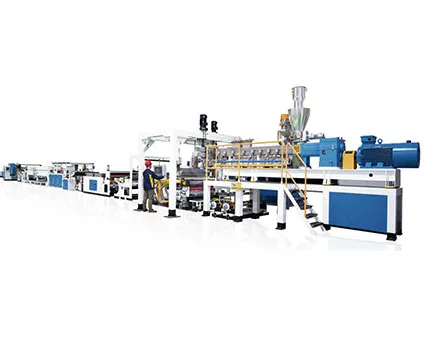
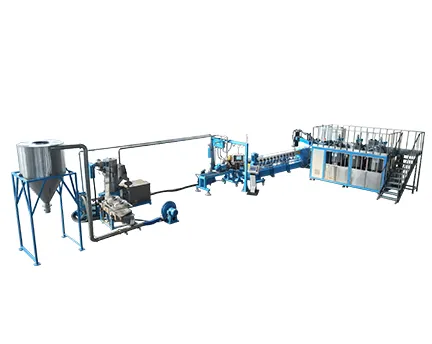
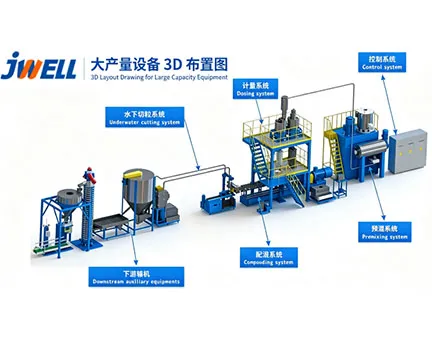
JWELL's published TPU reaction-extrusion configuration includes storage tanks, a pouring machine, casting head, twin-screw extruder, side feeder, underwater pelletizing, dewatering, screening, drying and packing equipment. Its listed TPU reaction models cover nominal capacity ranges from 400-500 kg/h up to 1000-1500 kg/h. The liquid-dosing architecture, however, should still be selected around the customer's actual formulation and material properties.
When TPU behavior changes during a run, operators should check the dosing data before immediately changing screw speed or barrel temperature. Useful checks include pump command versus measured consumption, reactant temperature, feed pressure, tank weight, current density data, moisture condition and recent pump calibration.
If the actual feed ratio has changed, adjusting the extrusion profile may only mask the real cause. Separating a dosing or chemistry problem from a mixing or extrusion problem makes troubleshooting faster and reduces unnecessary process changes.
No. The pump ratio should be derived from the required chemical formulation and verified against actual flow.
They can help keep temperature-sensitive reactants within a stable viscosity range, improving repeatability when the material requires thermal conditioning.
Temperature variation, pressure changes, inaccurate density data, pump wear, suction problems, calibration drift and moisture contamination are common checks.
Liquid metering pumps in TPU reactive extrusion should be treated as chemistry-control devices. A robust system connects formulation, equivalent ratio, mass flow, pump calibration, actual-flow verification and the twin-screw reaction conditions. For manufacturers planning a complete line, JWELL's TPU reactive extrusion equipment provides the commercial equipment context while the final dosing design can be matched to the specific TPU formulation and production target.