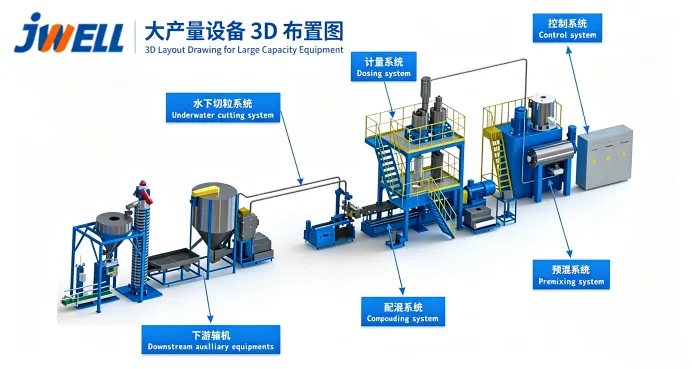
Producing a PLA, PBAT and starch blend requires more than simply feeding several biodegradable materials into an extruder. The materials have different melt behaviors, moisture sensitivities and compatibility characteristics, so the compounding process must control feeding, plasticization, dispersion, residence time and degassing in sequence.
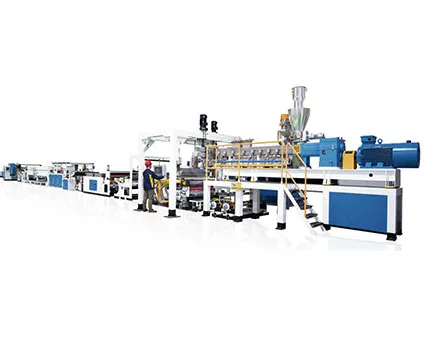
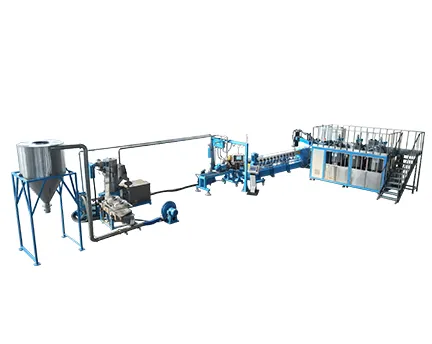
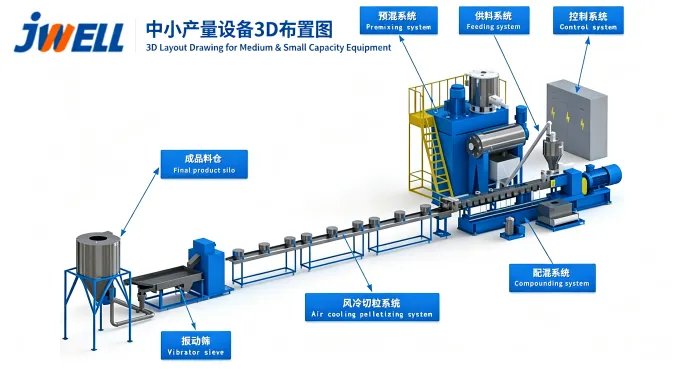
A modern biodegradable compounding machine typically uses a co-rotating twin-screw configuration because the process requires controlled melting and intensive mixing. JWELL's Biopolymer Compounding Extruder Machine is designed for systems including PBAT, PLA and starch and combines high-torque twin-screw processing with multi-stage vacuum venting and optional underwater pelletizing.
The finished compound can then be pelletized and supplied to downstream processes such as blown film, bags, packaging or other biodegradable products.
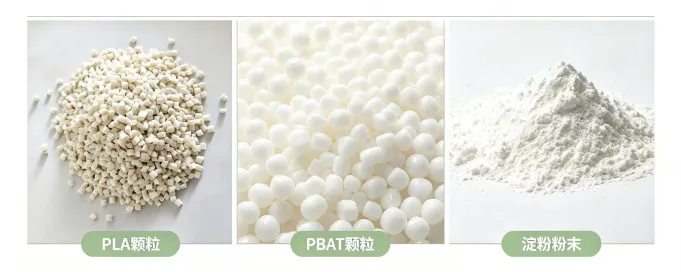
The compounding process begins with formulation and raw-material preparation.
A typical system may contain PLA, PBAT and thermoplastic starch (TPS), together with plasticizers, compatibilizers, processing aids or mineral fillers depending on the target product.
The formulation determines how the twin screw extruder machine should be configured. PLA provides stiffness and strength, while PBAT is commonly used to improve flexibility and toughness. Starch can reduce fossil-polymer content but introduces additional moisture and compatibility considerations.
Research published in Green Chemistry explains that PLA/PBAT blends are widely studied for improving the balance of mechanical properties, while compatibilization can improve interaction between the polymer phases.
Therefore, formulation is the starting point for determining screw configuration and processing conditions.
Moisture control is one of the first critical steps.
PLA is particularly sensitive to hydrolytic degradation during melt processing. Starch-based components can also introduce significant moisture because starch is naturally hydrophilic.
Before entering the twin screw machine, raw materials should therefore be prepared according to their moisture requirements. Drying systems, sealed conveying and controlled feeding can help maintain stable material conditions.
Recent experimental work on PLA/thermoplastic starch systems demonstrates this practical requirement. In one study, PLA and TPS components were dried before melt processing, highlighting the importance of moisture removal when preparing biodegradable polymer blends. Source: Nature – PLA/Thermoplastic Starch Blend Processing
The exact drying temperature and time should be determined by the resin supplier and formulation rather than applying one universal setting.
Once the materials are prepared, loss-in-weight or volumetric feeders introduce them into the extrusion system.
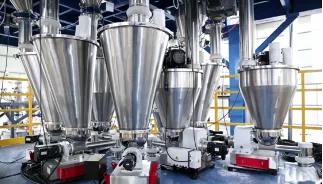
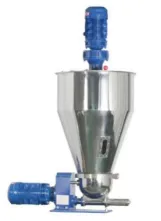
Consistent feeding is essential because changing the PLA/PBAT/starch ratio can alter melt viscosity, phase morphology and final mechanical performance.
Different ingredients may also be introduced at different points. For example, a main polymer feed may enter at the beginning of the barrel, while sensitive additives or fillers can be introduced downstream after the primary polymers have formed a stable melt.
This is where a twin extruder machine provides an advantage over a simple single-screw system. The modular screw arrangement allows conveying, melting, distributive mixing and dispersive mixing to be arranged along different processing zones.
Inside the double screw extruder machine, mechanical energy and barrel heating progressively transform the solid feed into a polymer melt.
The objective is not simply to reach a high temperature. The process must establish sufficient melting and mixing while avoiding excessive thermal or mechanical stress.
PLA has a relatively narrow processing window, and excessive thermal or shear exposure can reduce molecular weight and negatively affect properties. Research on reactive extrusion of PLA/PBAT systems has specifically investigated polymer degradation under processing conditions.
For this reason, screw speed, barrel temperature, feed rate and residence time need to be considered together.
After the polymer components begin to melt, the twin screw compounding machine must distribute the phases throughout the melt.
PLA and PBAT do not automatically form a perfectly compatible single phase. Starch introduces another interface into the system.
Screw elements can therefore be arranged to provide a combination of distributive and dispersive mixing. The goal is to break up larger domains, distribute the components uniformly and establish a repeatable morphology.
Research on PLA/PBAT/PBS blends has shown that reactive blending can refine morphology and improve rheological behavior sufficiently for subsequent film extrusion.
This demonstrates why the compounding stage is not merely a material-mixing operation. It directly influences the processability of the final compound.
Additional ingredients can be introduced depending on the formulation.
For starch-rich systems, plasticizers can help convert starch into thermoplastic starch. Compatibilizers may be used to improve interfacial adhesion between starch and polyester phases.
Fillers can also be incorporated when the target product requires cost reduction, stiffness or other functional properties.
The feeding location matters. Adding everything at the main feed throat can overload the initial melting zone or create poor dispersion. A downstream side feeder can be considered for selected powders, fibers or other ingredients.
JWELL identifies poor dispersion, volatiles, plasticizer exudation and thermal degradation as key challenges in highly filled biopolymer systems. Its solution combines high-torque twin-screw processing with multi-stage vacuum venting.
After the major components have been incorporated, the compound moves through homogenizing sections.
At this stage, the twin screw extrusion machine needs to create a stable melt with consistent composition and temperature.
The operator monitors variables such as:
Melt temperature
Melt pressure
Screw speed
Feed rate
Motor load
Vacuum level
Output rate
The objective is a compound that behaves consistently during pelletizing and later conversion.
Degassing is especially important for starch-containing formulations.
Residual moisture, plasticizer vapors and other volatile substances can cause bubbles, surface defects or instability during subsequent film extrusion.
JWELL's biopolymer compounding system uses multi-stage vacuum venting to remove moisture, residual monomers, plasticizers and other volatiles from the melt.
This stage becomes particularly valuable when the compound will later be processed into thin films, where even small amounts of residual volatiles can become visible defects.
Once the melt has been homogenized and degassed, it exits through the die.
For conventional strand pelletizing, the compound is formed into strands, cooled and then cut into pellets. JWELL also lists underwater pelletizing as an optional system for high-viscosity and heat-sensitive materials.
The choice of pelletizing system depends on compound viscosity, throughput, cooling behavior and the required pellet characteristics.
The goal is to produce uniform pellets that can be stored, transported and consistently reprocessed.
| Process Stage | Main Operation | Key Control Point |
| Raw-material preparation | Drying and formulation | Moisture and composition |
| Feeding | Metering PLA, PBAT and starch | Feed-rate stability |
| Melting | Progressive plasticization | Temperature and residence time |
| Mixing | Distributive and dispersive mixing | Phase dispersion |
| Additive introduction | Plasticizers, compatibilizers or fillers | Feeding position |
| Homogenization | Stabilizing the melt | Temperature and pressure |
| Degassing | Removing moisture and volatiles | Vacuum level |
| Pelletizing | Strand or underwater pelletizing | Pellet uniformity |
| Quality control | Testing compound properties | Consistency between batches |
JWELL lists several configurations for its biopolymer compounding system.
| Model | Max. Motor Power | L/D Ratio | Max. Screw Speed | Reference Capacity |
| CJWH-65 | 75 kW | 40–56 | 300 rpm | 240 kg/h |
| CJWH-75 | 132 kW | 40–56 | 300 rpm | 440 kg/h |
| CJWS-65 | 90 kW | 40–56 | 266 rpm | 310 kg/h |
| CJWS-75 | 160 kW | 40–56 | 300 rpm | 550 kg/h |
| CJWS-75 Plus | 200 kW | 44–56 | 330 rpm | 700 kg/h |
These published figures are reference capacities rather than universal production rates. Actual throughput depends on formulation, bulk density, moisture, filler loading, screw configuration and processing conditions.
When comparing twin screw extruder machine manufacturers, buyers should evaluate the formulation first and machine second.
A PLA/PBAT system does not necessarily require the same screw design as a starch-rich compound. The screw should provide the required melting, mixing and residence-time profile.
For PLA and starch-containing systems, drying and vacuum venting should be treated as core process equipment rather than optional accessories.
If the compound contains a high proportion of starch or mineral filler, the torque capacity and screw design become increasingly important.
Strand pelletizing may be suitable for many formulations, while underwater pelletizing can be considered for compounds requiring a more enclosed cooling and pelletizing process.
A twin-screw system provides controlled conveying, melting and intensive mixing, allowing PLA, PBAT, starch and additives to be combined into a more uniform compound.
Excessive thermal or mechanical exposure can cause degradation and molecular-weight loss. Processing conditions therefore need to be matched to the specific PLA grade and formulation.
Starch is hydrophilic and can introduce moisture into the extrusion process. It may also require plasticization and compatibilization when blended with hydrophobic biodegradable polyesters.
Yes. Research has demonstrated one-step extrusion approaches for thermoplastic starch, PLA and PBAT systems, although the required screw design and formulation depend on the target properties.
The extrusion process normally produces pellets or granules that can be used in subsequent processes such as blown-film extrusion, injection molding, sheet extrusion or other polymer-processing operations.
A PLA, PBAT and starch blend is created through a controlled sequence rather than simple melting and mixing. Raw materials must first be prepared and metered accurately, followed by progressive melting, intensive dispersion, additive incorporation, homogenization and vacuum degassing. The final melt is then pelletized into a stable compound for downstream processing.
A properly configured twin screw machine is central to this process because its screw arrangement, torque capacity and processing zones can be adapted to different biodegradable formulations.
For manufacturers evaluating a bioplastic machine, the most important consideration is therefore the complete process: formulation, feeding, screw design, moisture management, degassing and pelletizing must work together to deliver consistent PLA/PBAT/starch compounds.