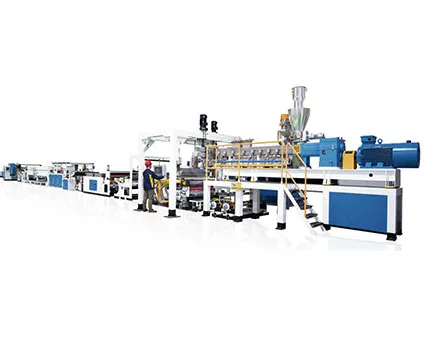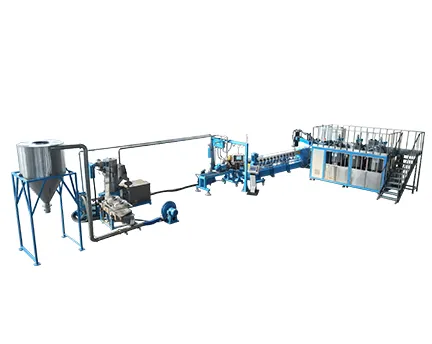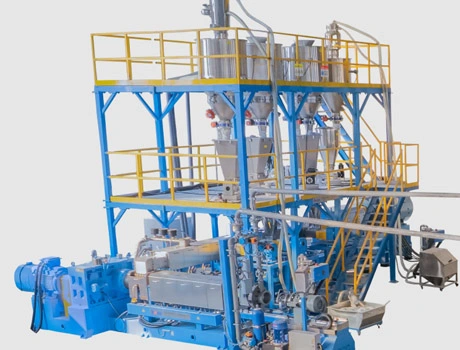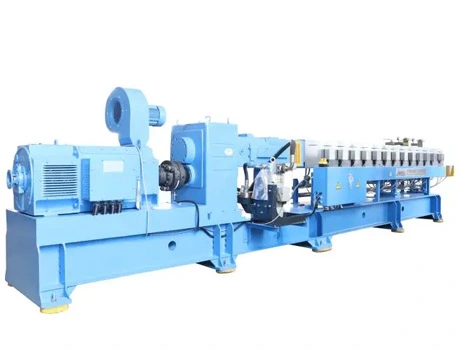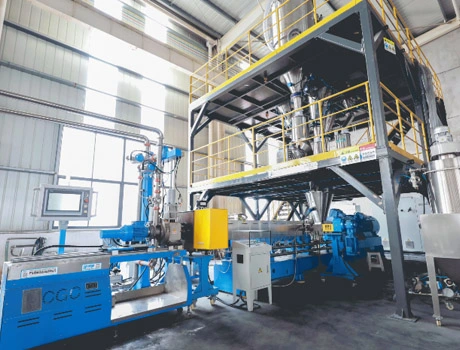
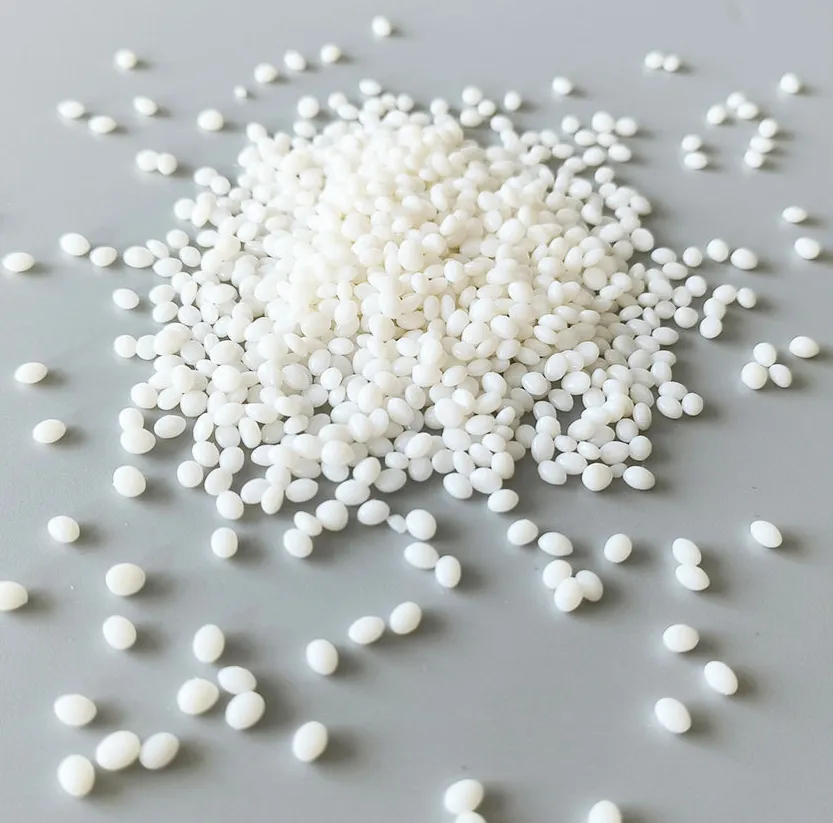
Compounding of biopolymers constitutes the first preparation process for the modification of plastics by means of extrusion following the production of the base polymer. Throughout the preparation, characteristic feature of the plastics can be selectively changed.
Hereby, it is adapted to the next process and targeted product characteristics.The plastic is melted inside the extruder where it is blended with additives, fillers, reinforcing materials or a combination of them. After homogenization and degassing of the compound, it is formed – usually as strands – by using a tool, then cooled and processed into plastic granules. In the compounding process, numerous effectors arise before processing and during it. Depends on the type of plastic, these factors are evident in variable degrees and affect it’s mechanical, thermal, (chemical) and rheological properties as well.
Poor dispersion in high filling. At 20-30% loading, standard screws lack shear force, causing filler agglomeration and weak mechanical properties.
Volatiles and exudates. Starch-based materials smoke during film blowing. Plasticizers migrate to the surface, making film sticky and affecting printing and heat sealing.
Thermal degradation. PLA has a narrow window. Over-shearing or high temperature breaks polymer chains, causing yellowing and performance loss.
High-torque twin screw. CJWS Plus series with super high-torque gearbox ensures even dispersion of highly filled systems. Wear and corrosion-resistant screws and barrels extend service life.
Multi-stage vacuum venting. Removes moisture, residual monomers, plasticizers and volatiles. Reduces smoking in downstream film blowing and minimizes exudation.
Underwater pelletizing (optional). Closed system, no dust. Produces round, uniform pellets, suitable for high-viscosity and heat-sensitive materials.
Turnkey line & process support. From feeding to downstream equipment. R&D center with test machines for formula and process verification.
With global bioplastics demand growing, this line enables higher filler loadings to reduce material costs. Compounds produced help meet EU PPWR renewable content requirements and ASTM D6400/EN 13432 compostability standards for export markets.
| Material System | Product Application |
| PBAT, PLA, Starch | Courier bags, shopping bags, trash bags |
| PBAT, PLA | High-end film products (high transparency) |
| PBAT, PLA, Mineral powder | Shopping bags, trash bags, courier bags, retail bags, industrial packaging |
| PBAT | Agricultural mulch film series |
| PLA, PBS | Heat-resistant, crystalline, room-temperature straws, Disposable tableware (cutlery, spoons, forks, knives) |
| PBT | Electronics, automotive parts, connectors, etc. |
| Extruder | Max. motor power N[kW] | L/D ratio | Max. screw speed[min⁻¹] | Capacity for reference[Hr⁻¹] |
| CJWH-65 | 75 | 40-56 | 300rpm | 240kg |
| CJWH-75 | 132 | 40-56 | 300rpm | 440kg |
| CJWS-65 | 90 | 40-56 | 266rpm | 310kg |
| CJWS-75 | 160 | 40-56 | 300rpm | 550kg |
| CJWS-75 Plus | 200 | 44-56 | 330rpm | 700kg |