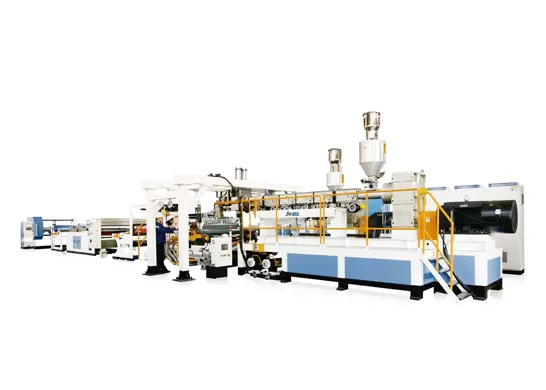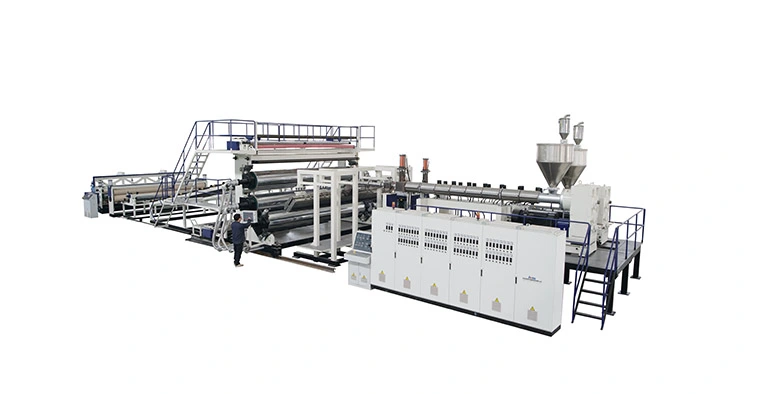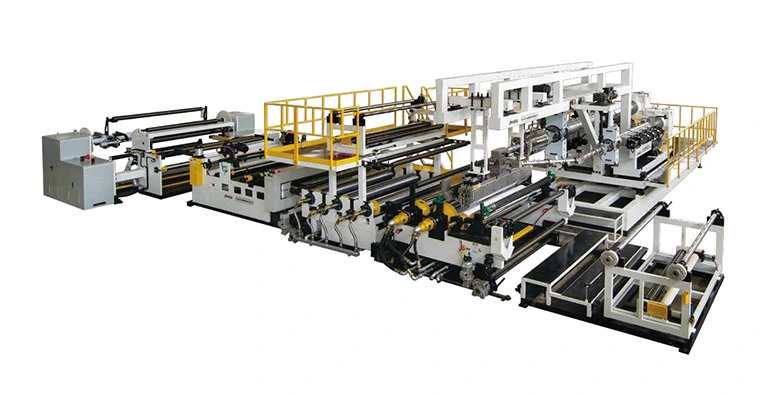
In India, JWELL supplied a PVC waterproofing membrane extrusion line. The line is rated for a stated capacity of 2,000 kg/h and is configured for a finished product width of 2,000 mm (2 m), producing PVC waterproofing membranes (roll goods). The project highlights a high-output PVC membrane line of 2,000 kg/h at 2 m finished width. The complete scope covers the multi-component automatic weighing and dosing system, the main extruder, the flat T-die, a vertical three-roll stack, a cooling cradle, an automatic thickness gauge, a heating oven, a non-woven fabric lamination unit, the haul-off unit, the cooling section, a sheet accumulator and an automatic winder. Final installation, commissioning and acceptance data will be published after confirmation with the customer.
Project: PVC waterproofing membrane extrusion line
Location: India
Completion Year: 2026
Customer Industry: [To be confirmed]
Raw Material: flexible PVC compound
Production Line: PVC waterproofing membrane extrusion line with vertical three-roll stack, non-woven fabric lamination and automatic winding
Stated Production Capacity: 2,000 kg/h
Finished Product Width: 2,000 mm (2 m)
Finished Product: PVC waterproofing membranes (roll goods)
Main Applications: single-ply roofing membranes; basement and below-grade waterproofing; tunnel and underground waterproofing; building and civil waterproofing systems
Line Scope: multi-component automatic weighing and dosing system; main extruder; flat T-die; vertical three-roll stack; cooling cradle; automatic thickness gauge; heating oven; non-woven fabric lamination unit; haul-off unit; cooling section; sheet accumulator; automatic winder
This project required a production solution for PVC waterproofing membrane in India. The customer operates in South Asia and commissioned the line in 2026 to supply PVC waterproofing membranes (roll goods) for single-ply roofing membranes and related applications.
Because the membrane is produced from a multi-component PVC compound and is finished with a laminated non-woven backing, the line also requires accurate gravimetric dosing of all components, stable melt homogeneity and reliable tension control through the lamination, cooling and winding sections.
Compared with standard-width flat extrusion, a line at 2,000 mm (2 m) finished width with a stated output of 2,000 kg/h places higher demands on melt distribution, thickness control, cooling, web handling and the coordination of the complete production line.
[Customer name, company profile and target end-market details to be confirmed - the case can be published anonymously if preferred.]
- A PVC waterproofing membrane extrusion line with a stated output of 2,000 kg/h
- Finished product width of 2,000 mm (2 m)
- Multi-component automatic weighing and dosing for PVC resin, plasticizer, stabilizers and fillers
- Consistent thickness control and stable product quality across the full width
- In-line automatic thickness gauging for closed-loop thickness control
- Heating oven and non-woven fabric lamination for a reinforced, dimensionally stable membrane
- Coordinated forming, cooling, haul-off and downstream handling equipment
- Sheet accumulator and automatic winder for continuous winding under controlled tension
- Stable continuous operation suitable for routine industrial production
- Technical support for the overseas installation and commissioning phase
- [Additional customer-specific requirements and quality standards to be confirmed]
JWELL supplied a PVC waterproofing membrane extrusion line solution based on its JWELL PVC waterproofing membrane extrusion platform. The line starts with a multi-component automatic weighing and dosing system that feeds PVC resin, plasticizer, stabilizers and fillers in controlled proportions to the main extruder, where the compound is plasticated and homogenized into a uniform melt. The melt is distributed by a flat T-die and formed on a vertical three-roll stack, whose roll temperatures and surface finish set the membrane surface, gauge and dimensional stability. The membrane then passes over a cooling cradle and an automatic thickness gauge, which monitors and supports closed-loop gauge control, before entering a heating oven that conditions the web ahead of the non-woven fabric lamination unit, where a non-woven backing is combined with the membrane. After lamination the membrane is pulled by a haul-off unit, cooled in the cooling section, buffered in a sheet accumulator and wound on an automatic winder under controlled tension.
The line was proposed at a stated output of 2,000 kg/h for a finished width of 2,000 mm (2 m). The final screw configuration, die size and downstream layout are defined during project review according to the raw material formulation, product specification and factory conditions. [Extruder model, melt filtration arrangement and detailed customization decisions to be confirmed.]
| Project Item | Configuration |
| Finished Product | PVC waterproofing membranes (roll goods) |
| Product Width | 2,000 mm (2 m) |
| Stated Capacity | 2,000 kg/h |
| Raw Material | flexible PVC compound |
| Main Extruder(s) | Main extruder (JWP150 reference; final model and configuration to be confirmed) |
| Feeding and Dosing System | Multi-component automatic weighing and dosing system (PVC resin, plasticizer, stabilizers and fillers) |
| Melt Filtration | Screen changer / melt pump as configured for the material |
| Flat Die | 2,200 mm |
| Forming Section | Vertical three-roll stack for membrane forming and surface finishing |
| Cooling and Haul-Off | Cooling cradle, haul-off (traction) unit and cooling section |
| Downstream Finishing | Heating oven and non-woven fabric lamination unit; automatic thickness gauge; sheet accumulator; automatic winder |
| Control System | PLC + HMI automatic line control |
| Project Market | India |
Note: The table above is a reference configuration for the corresponding JWELL extrusion platform. Final equipment list and model numbers depend on raw material formulation, product specification, target capacity and site conditions.
Multi-component PVC automatic weighing and dosing system → Main extruder plasticating and melt extrusion → Melt filtration and homogenization → Flat T-die → Vertical three-roll stack → Cooling cradle → Automatic thickness gauge → Heating oven → Non-woven fabric lamination → Haul-off unit → Cooling section → Sheet accumulator → Automatic winder
Flexible PVC waterproofing membrane is produced from a plasticized, multi-component compound; the automatic weighing and dosing system ensures that PVC resin, plasticizer, stabilizers and fillers are fed in accurate proportions, and the main extruder plasticates the compound into a well-gelled, homogeneous melt. The melt is filtered and homogenized before entering a flat T-die.
The web is formed and finished on a vertical three-roll stack, whose roll temperatures and surface finish determine the membrane surface and gauge. The membrane is then stabilized on a cooling cradle and its thickness is monitored continuously by an automatic thickness gauge to support closed-loop gauge control. A heating oven conditions the web ahead of the non-woven fabric lamination unit, where a non-woven backing is applied to give the membrane additional reinforcement and dimensional stability. After lamination, the membrane is pulled by a haul-off unit, further cooled in the cooling section, buffered in a sheet accumulator and wound on an automatic winder under controlled tension, producing flexible, weldable PVC membrane for roofing and waterproofing applications at the stated output and width.
Note: The final line configuration can be adjusted according to the raw material formulation, product thickness, surface structure, roll width, production capacity and the level of automation required.
"The installation and commissioning scope for this project covers the multi-component automatic weighing and dosing system, the main extruder, the flat T-die, the vertical three-roll stack, the cooling cradle, the automatic thickness gauge, the heating oven, the non-woven fabric lamination unit, the haul-off unit, the cooling section, the sheet accumulator and the automatic winder.
During trial production the technical team checks the coordination of the complete line, including extrusion stability, melt distribution across the working width, forming and cooling, gauge control, lamination quality, haul-off synchronization and wound-roll quality.
Installation duration: 7 days
Commissioning duration: 5 days
Technical support: [On-site / Remote / Both]
Acceptance method: [FAT / SAT / Customer production test]
Operator training: [Operation / Maintenance / Process adjustment]
Following installation and parameter adjustment, the production line undergoes trial production and project verification. The verification process focuses on production capacity, product width, thickness control, continuous operating stability and finished-product quality.
| Verification Item | Project Target | Verified Result |
| Production Capacity | 2,000 kg/h | 2,000 kg/h |
| Finished Product Width | 2,000 mm (2 m) | 2,000 mm (2 m) |
| Product Thickness | 0.5-3mm | 0.5-3mm |
| Final Acceptance | Customer project requirements | [Passed FAT/SAT on date] |
Depending on the raw material formulation and the finished product specification, the output of this line can be used for:
- single-ply roofing membranes
- basement and below-grade waterproofing
- tunnel and underground waterproofing
- building and civil waterproofing systems
[To confirm: actual product dimensions, surface type, layer structure, roll/cut length and the applicable product standard.]
Q: What is the capacity of the India PVC waterproofing membrane project?
A: The stated production capacity of this project is 2,000 kg/h.
Q: What is the finished product width of the India PVC waterproofing membrane line?
A: The line is configured for a finished product width of 2,000 mm (2 m).
Q: What is the difference between PVC and TPO waterproofing membranes?
A: PVC membranes use plasticized PVC, while TPO membranes use a thermoplastic polyolefin formulation. Both are single-ply systems, and the material choice depends on the project standard, exposure conditions, and cost target.
Q: What information is needed to configure a similar extrusion line?
A: Buyers should provide the required product width, thickness range, raw material formulation, layer structure, surface type, target capacity, roll dimensions, electrical standard, and workshop limitations. JWELL can then evaluate the extruder and downstream equipment configuration.
Q: What is the delivery and installation time for a similar project?
A: To be confirmed. Delivery time depends on the line configuration, customization scope, and production schedule at the time of order.