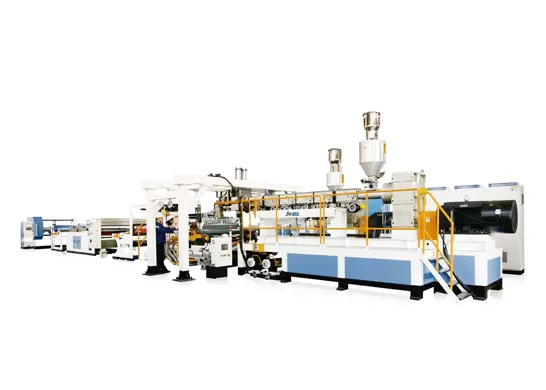
A food tray can be made from PP or PET. Both resins extrude into sheet, both thermoform at high production rates, and both end up in packaging. But that does not mean a PP sheet extrusion line and a PET sheet extrusion line are selected the same way.
The real differences appear before the resin reaches the extruder and continue through melting, moisture control, filtration, calendering, cooling and recycling. They change the equipment configuration, the operating complexity, the energy bill and — most importantly — the markets a sheet producer can serve.
If you are evaluating a new line, the first question is not "Which machine has the highest output?" It is: "What sheet do we intend to sell, and which processing route makes sense for that material?"
Choose the resin from the finished sheet and its end market — not from a machine brochure.
PP means simpler moisture handling, stable output and good toughness for thermoforming, food packaging and stationery sheet.
PET buys clarity, stiffness and barrier performance, but moisture control (or devolatilization) is a core design decision, not an accessory.
Recycled content changes the line design — dosing, filtration, degassing and screw configuration must be discussed before ordering, not "later".
Judge the complete line — die, three-roll calender, cooling, haul-off and winding — at your target output, never the extruder alone.
Buyers sometimes start by comparing screw diameter, motor power and kilograms per hour. Those numbers matter, but they come later. PP and PET are chosen for different combinations of product performance and downstream requirements, so define where the sheet goes after it leaves your factory before comparing machines.
Decision point | PP sheet | PET sheet |
Typical market direction | Thermoforming, food packaging, stationery, selected industrial sheet | Transparent thermoforming packaging, trays, blister-type and related packaging |
Transparency | Grade-, design- and processing-dependent | Commonly chosen where high clarity matters |
Moisture sensitivity in processing | Low for neat PP | High — moisture can cause hydrolytic degradation at melt temperature |
Conventional drying need | Rarely required for properly stored neat PP; additives, fillers or regrind may change this | Normally a major process consideration unless using a system engineered for dryer-free processing |
Recycled-material handling | Depends on contamination, melt-flow stability and sheet spec | Needs attention to moisture, contamination and viscosity retention |
Line priority | Stable plasticization, output, gauge control, cooling | Moisture/devolatilization management, viscosity retention, filtration, cooling, gauge control |
Polypropylene is non-hygroscopic — it does not absorb atmospheric moisture into the polymer the way PET does. For properly stored neat PP, intensive desiccant drying is generally not the central process requirement.
That does not mean moisture can be ignored. Condensation, recycled feedstock, pigments, fillers and other additives can introduce surface moisture or change handling requirements. Preparation should be confirmed against the actual formulation. (For background on PP moisture behaviour, see the Asahi Kasei polypropylene processing guide.)
PET is hygroscopic. If too much moisture stays in the material at extrusion temperature, hydrolysis reduces molecular weight and intrinsic viscosity (IV). That shows up as weaker melt strength, less stable processing and a softer, less consistent finished sheet. Technical literature on PET extrusion consistently links moisture to hydrolytic degradation during melt processing .
This is why conventional PET plants put drying and moisture control at the centre of the line design — and why the real question is not "do we need drying?" but "how will we manage moisture?"
PET is dried to the required moisture level before extrusion, so the dryer, conveying system and raw-material storage become core parts of the plant. Note that CPET needs two steps — crystallizing first, then drying — because amorphous PET pellets soften and stick in a dryer if they are not crystallized first. Typical targets sit in the 0.002–0.005 % moisture range before melt processing.
A twin-screw system with effective devolatilization can run without a separate conventional drying and crystallization unit. JWELL's PET sheet twin-screw extrusion line uses a vented twin-screw configuration with degassing, designed around this dryer-free concept.
Being clear about the boundary: dryer-free vented extrusion is not a universal substitute for drying. It suits plant strategies built around well-managed flake and virgin feed, where the screw's degassing capacity and vacuum system can hold moisture and volatiles within spec. It should be evaluated on IV retention data from reference installations, not on a brochure claim. Ask the supplier for both — the data sheet and the operating record.
Neither route is universally superior. Evaluate energy use, raw-material condition, recycled-content strategy, required output, operator experience, floor space and product-quality targets before choosing. On JWELL PET lines both routes are available, so the choice is made around the customer's material handling and production plan rather than around a single machine type.
A PP line and a PET line can look similar from a distance — extruder, flat die, calender rolls, cooling, edge trimming, haul-off, winding or cutting. The difference is how those components are configured around the polymer.
Production area | PP sheet line focus | PET sheet line focus |
Raw-material preparation | Stable feeding; manage additives, regrind and any surface moisture | Moisture control, virgin/recycled ratio and stable feeding are major priorities |
Extrusion | Stable melting, plasticization, homogeneous melt delivery | Stable melting while limiting viscosity loss and managing volatiles |
Filtration | Sized to material cleanliness, regrind and sheet-quality target | Especially important with recycled PET or demanding visual quality |
Flat die | Uniform melt distribution across the width | Uniform distribution with close control of gauge and appearance |
Calendering / cooling | Thickness control, surface condition, dimensional stability | High cooling efficiency and controlled sheet formation for clarity and stable production |
Recycled material | Manage melt-flow variation and contamination to sheet spec | Manage moisture, contamination, IV variation and filtration demand |
The extruder gets the attention, but the finished sheet is not made by the screw alone. Once the melt leaves the flat die, the roll stack must cool and shape the sheet while controlling thickness, surface quality and dimensional stability. Poor temperature uniformity or insufficient cooling capacity will cap the performance of an otherwise capable extruder — the moment output rises, the line must remove heat fast enough to hold sheet quality, not simply accept more melt.
A useful buying rule: do not judge line capacity from extruder output alone. Ask whether the die, calender rolls, cooling system, haul-off and downstream equipment hold the required thickness and surface quality at that output. On JWELL lines, roll-stack cooling capacity is matched to extruder output during project engineering, which is why we quote complete line configurations rather than a screw size.
A line designed only for virgin resin is often not the right line for a factory that intends to raise recycled content later. Recycled feedstock adds variability in particle form, contamination level, melt characteristics, colour and feeding stability. With PET, moisture and IV retention add another layer of process control.
This affects decisions on:
Virgin-to-recycled dosing ratios
Conveying and material preparation
Melt filtration
Degassing
Screw configuration
Melt-pressure stability
Colour and visual quality control
JWELL's PET twin-screw line includes multi-component dosing for virgin material, recycled flake and masterbatch — relevant for producers planning several feed streams on one line. If your roadmap includes 30 %, 50 % or higher rPET later, say so in the inquiry: the difference between "maybe later" and "from day one" can change the dryer, the screen changer and the screw spec.
Choose the PP route when the product values toughness, chemical resistance, low density and thermoforming capability, and the factory will produce:
PP thermoforming sheet for suitable food and consumer packaging
PP stationery sheet
Single-layer or multilayer PP sheet
Coloured, matt or application-specific PP sheet
JWELL's PP/PS sheet extrusion line is built for thermoforming, packaging and PP stationery-type sheet.
Choose the PET route when the market needs PET's clarity, stiffness and packaging performance, including:
Transparent thermoforming packaging
Food and consumer trays on suitable PET grades
APET sheet
PETG sheet applications
CPET-type applications with the appropriate crystallizing-drying-processing route
Production strategies incorporating suitable recycled PET
JWELL offers PET twin-screw sheet extrusion and PET single-screw sheet extrusion, so the process route can be selected around material handling and production requirements.
Published specifications help map the range of configurations, but they are not a substitute for project engineering.
JWELL line | Sheet thickness | Capacity range | Notable process feature |
PP/PS sheet extrusion line | 0.3–2 mm | 400–1000 kg/h by model | Standard PP/PS production for thermoforming, packaging and related applications |
PET twin-screw sheet extrusion line | 0.15–2.0 mm | up to 1500 kg/h by configuration | Vented twin-screw system designed for dryer-free PET sheet processing + crystallization |
PET single-screw sheet extrusion line | 0.15–2.0 mm | up to 800 kg/h by configuration | Drying + crystallization |
Final capacity and configuration depend on material grade, sheet structure, width, thickness, recycled content and project requirements. Send those details and ask for a line proposal rather than a machine list.
Factory A — high-volume thermoforming producer with a clear PP programme. The priority is stable output, gauge control, efficient cooling and reliable downstream operation. A dedicated PP line makes more sense than absorbing PET moisture-management complexity the market does not require.
Factory B — transparent packaging producer planning virgin and recycled PET. Priorities are material dosing, moisture/devolatilization strategy, filtration, viscosity retention and clarity. A vented PET twin-screw configuration becomes particularly interesting because the whole process is engineered around PET rather than being a conventional line "running PET".
Factory C — new investor still choosing between PP and PET. Priorities are not yet defined and the comparison is price and maximum output. Do not order yet: first confirm the target sheet specification, end market, customer-required material, recycled-content target, annual volume and thermoforming requirements. The material should follow the business case, not the machine quotation.
Choosing the line from maximum kg/h. Maximum output is meaningless if cooling, gauge control or downstream equipment cannot hold quality at that rate.
Saying "we may use recycled material later". Recycled content should be on the table before equipment design, because it influences feeding, filtration, degassing, material preparation and quality control.
Comparing extruders and ignoring downstream equipment. Sheet thickness and surface quality come from the complete line: die, calender, temperature control, trimming, haul-off, winding or cutting.
Treating all PET extrusion routes as identical. A conventional dried-material PET process and a dryer-free vented twin-screw process have different layouts and operating demands — compare them as complete production systems.
Selecting PP or PET before talking to the downstream customer. If the sheet feeds thermoforming, understand the customer's tray design, forming equipment, temperature requirements, clarity expectations and material spec before finalizing the line.
A supplier can only give a meaningful recommendation from actual production requirements — not from "a 1,000 kg/h sheet machine". Prepare:
Material: PP, APET, PETG, CPET or another specified resin
Virgin and recycled percentages
Single-layer or multilayer structure
Required sheet width
Minimum and maximum thickness
Target output in kg/h
Finished application and thermoforming requirements
Transparency, colour and surface-quality requirements
Available utilities and factory space
Preferred winding, cutting and automation configuration
Yes, on a vented twin-screw line with adequate devolatilization, moisture and volatiles are removed inside the process, so no separate dryer unit is required. Suitability depends on the feed condition and the line's degassing capacity.
At melt temperature, residual moisture triggers hydrolysis, which cuts polymer chain length and lowers intrinsic viscosity (IV). The result is weaker melt strength, unstable processing and reduced sheet mechanical properties.
Virgin APET sheet grades commonly sit around 0.70–0.85 dL/g. Recycled flake usually enters lower, roughly 0.60–0.80 dL/g, so the line must minimize further IV loss to keep the finished sheet within spec.
The screw, venting and filtration layout differ according to the polymer, and PET demands greater attention to degassing and filtration, especially with recycled content. The die must deliver uniform distribution for either polymer, but gauge and appearance control targets differ.
Recycled flake adds variation in moisture, contamination, viscosity and feeding behaviour. Dosing accuracy, filtration capacity, degassing and screw configuration all need to be sized for the intended recycle ratio from the start.
Material and grades, virgin/recycled ratio, sheet width and thickness range, target output, end application and thermoforming requirements, utilities and floor space. With those, our engineers can propose a configured line rather than a generic model.
If the target market is already defined, the decision is simpler than it first appears.
Choose the PP route when PP matches the product performance required and the priority is a stable system for PP thermoforming, packaging, stationery or related sheet.
Choose the PET route when the market requires PET's clarity, stiffness and packaging characteristics — then decide whether a conventional configuration or a dryer-free vented twin-screw process better serves your production strategy.
Most importantly, do not reduce a material decision to a machine-price comparison. The better line is the one engineered around the sheet specification, the raw-material strategy, the downstream thermoforming process and the products your customers are actually buying.
JWELL supplies sheet extrusion systems for PP, PS, PET and other thermoplastics — feeding, extrusion, flat-die forming, calendering, cooling and downstream handling under one line configuration.
Download the PP vs PET line-configuration checklist (PDF) and use it in your inquiry
Compare the PP/PS sheet extrusion line
Review the PET twin-screw sheet extrusion line and PET single-screw sheet extrusion line
Explore more JWELL sheet extrusion solutions
Contact JWELL with your material, sheet dimensions, target output and end-use application — we will reply with a configured line proposal, not a price list
References: Asahi Kasei polypropylene processing guide;
PET extrusion research on hydrolytic degradation ;
JWELL technical blog — PET pre-crystallization and glass-transition temperature.