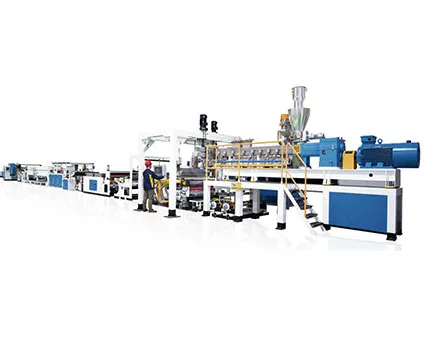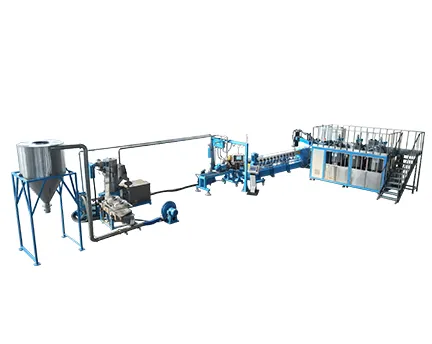
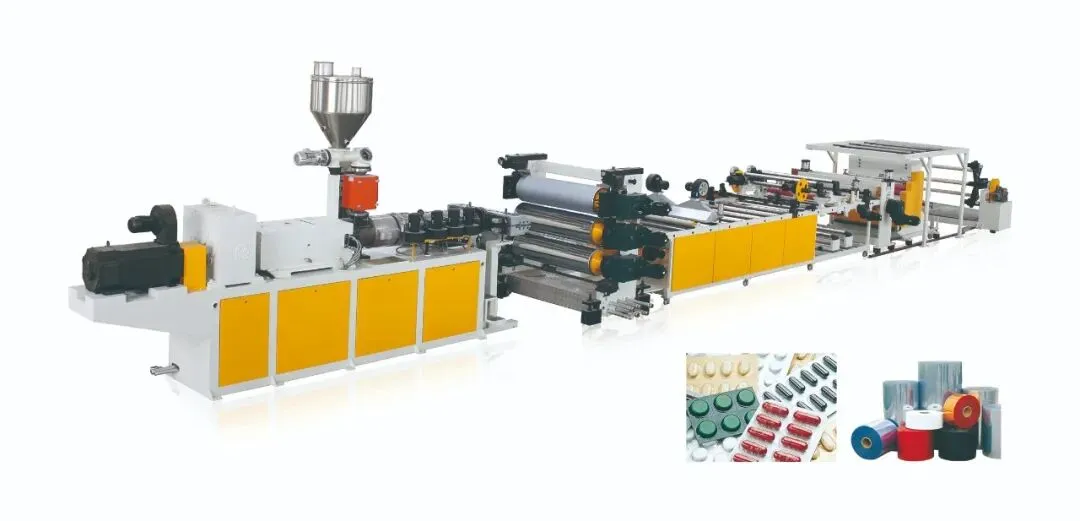
Rigid PVC sheet production starts long before the material reaches the flat die. Unlike many thermoplastics supplied directly as pellets, rigid PVC can enter extrusion as a formulated dry blend containing PVC resin, stabilizers, lubricants, impact modifiers, pigments and fillers. ASTM D1784 describes rigid PVC compounds as materials containing PVC together with necessary compounding ingredients and recognizes free-flowing or compacted powder blends among their forms — providing useful background on why dry-blend quality is closely connected with extrusion performance. This article walks through how a rigid PVC sheet extrusion machine converts dry blend into finished sheet, stage by stage, and what to evaluate when comparing china pvc rigid sheet extrusion line manufacturers.
The role of a PVC sheet extruder is to transform this prepared dry blend into a continuous, homogeneous sheet with controlled thickness, width, surface quality, and dimensional stability. JWELL's PVC sheet extrusion line is designed for applications including transparent rigid PVC sheet, with configurations listed for different widths, thickness ranges, and production capacities.
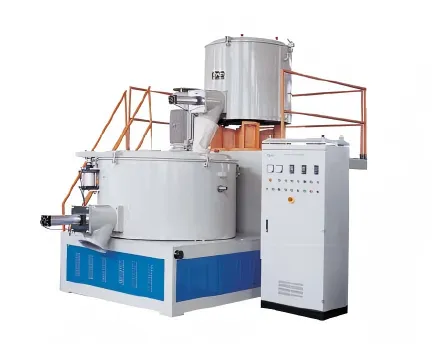
The first production stage is material preparation.
A rigid PVC dry blend normally contains the base PVC resin plus a carefully balanced package of additives. Depending on the finished sheet, the formulation may include thermal stabilizers, processing aids, lubricants, impact modifiers, pigments, and mineral fillers.
The objective is not simply to mix ingredients together. The blend must have sufficiently uniform composition and flow characteristics so that the sheet extrusion machine receives a consistent feed.
This is particularly important because PVC is thermally sensitive. If the formulation or processing conditions are inconsistent, the material can develop discoloration, surface defects, poor fusion, or unstable output.
For this reason, material consistency is the first control point in the complete production process.
Once the dry blend is prepared, it is transferred to the extrusion line's feeding system.
A controlled feeder supplies material to the extruder at a stable rate. The feeding system should prevent bridging, fluctuations, or sudden changes in bulk density that could affect output.
For rigid PVC, twin-screw extrusion is widely used because the screw system can provide controlled conveying, mixing, heating, and plasticization.
A processing guide from Teknor Apex on rigid PVC dryblend extrusion recommends conical or parallel twin-screw equipment with screw designs intended specifically for rigid PVC processing. It also emphasizes controlled temperature conditions and proper die care.
The feeding stage therefore determines how consistently the extruder receives the material that will eventually become the sheet.
The next stage is plasticization.
Inside the PVC sheet extruder, the dry blend is gradually transported along the screws. Heat from the barrel and mechanical energy generated by the screw system cause the material to soften and fuse.
The process must be controlled rather than simply heated as quickly as possible.
The main objectives are:
Consistent melting and fusion
Uniform additive distribution
Stable melt pressure
Controlled residence time
Prevention of excessive thermal degradation
Stable throughput
The screw design is especially important because rigid PVC requires a processing environment different from materials such as PP, PE, or ABS.
This is why a PP sheet extruder machine, for example, should not simply be assumed to be interchangeable with equipment optimized for rigid PVC.
After plasticization, the PVC becomes a continuous melt. At this point, temperature and pressure become two of the most important operating variables.
Excessive temperature or residence time can damage PVC, while insufficient plasticization can produce poor fusion and unstable sheet properties.
The operator therefore monitors variables such as:
| Process Stage | Main Control Point | Production Objective |
|---|---|---|
| Dry-blend feeding | Feed rate | Stable material supply |
| Screw conveying | Screw speed | Consistent throughput |
| Plasticization | Barrel temperature | Uniform fusion |
| Melt transport | Melt pressure | Stable flow |
| Die forming | Die temperature and gap | Uniform sheet |
| Calendering | Roll temperature and speed | Thickness and surface control |
| Trimming | Edge position | Consistent sheet width |
| Cutting/stacking | Length and alignment | Finished-product consistency |
The specific operating window should be established from the PVC formulation and equipment design rather than copied from another resin.
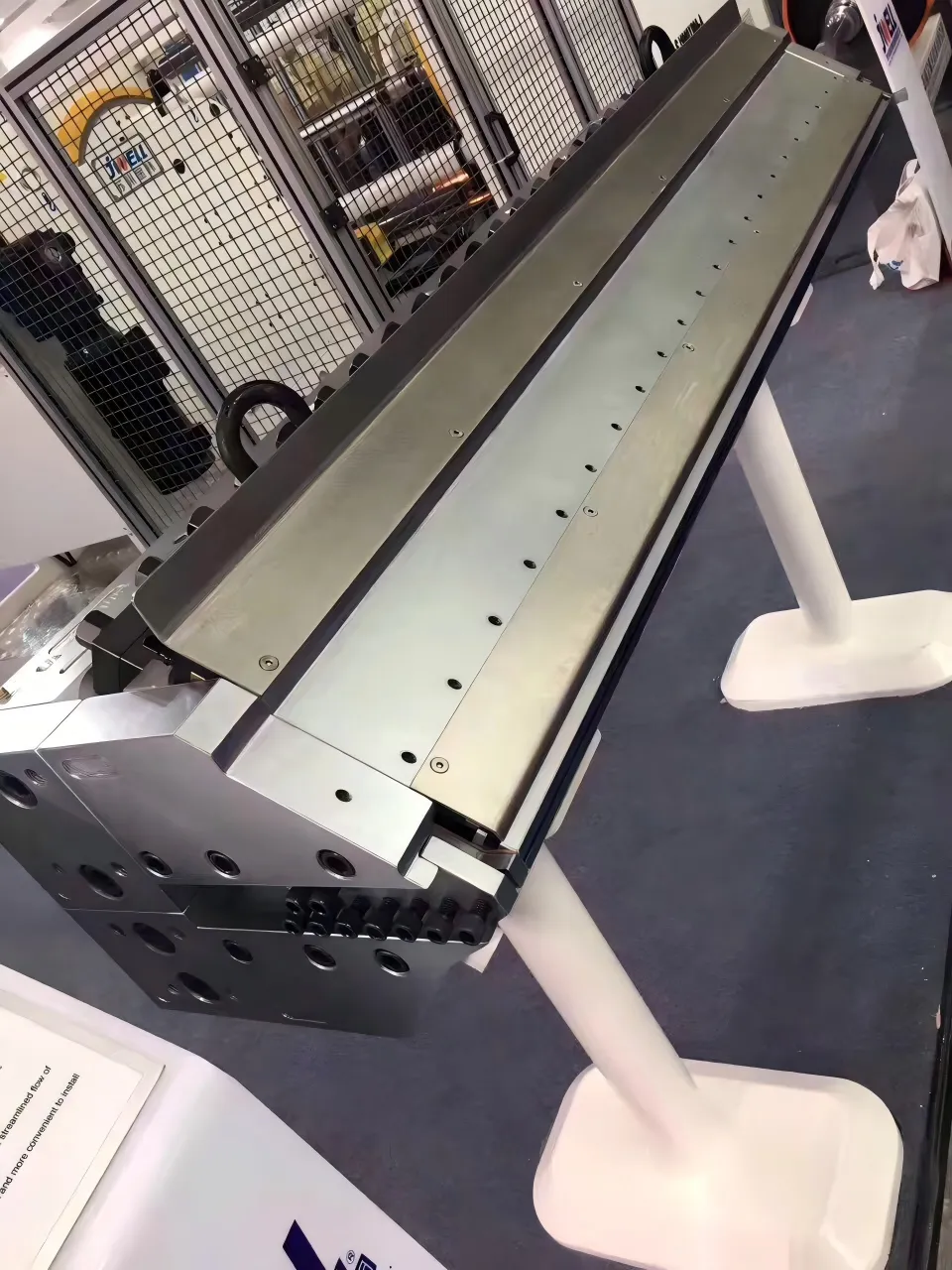
Once the melt is sufficiently homogeneous, it moves toward the flat die.
The die converts the pressurized polymer melt into a wide, continuous sheet. Die width and gap have a direct influence on the finished sheet dimensions.
This is one of the most critical stages of the sheet extrusion machinery, because a stable extruder cannot compensate for poor melt distribution through the die.
For example, uneven flow across the die can create variations in sheet thickness from one side to the other. Die-lip adjustment and temperature control can therefore be important tools for maintaining uniform output.
JWELL lists a PVC sheet extrusion configuration with product widths of up to 2,000 mm and thickness ranges of 0.3–1.5 mm for one listed model, while another configuration covers 1,220 mm width and 0.3–3 mm thickness. The same page lists capacities of approximately 500–600 kg/h and 300–400 kg/h respectively.
These specifications illustrate why die width, sheet thickness, and extruder capacity should be considered as one integrated system.
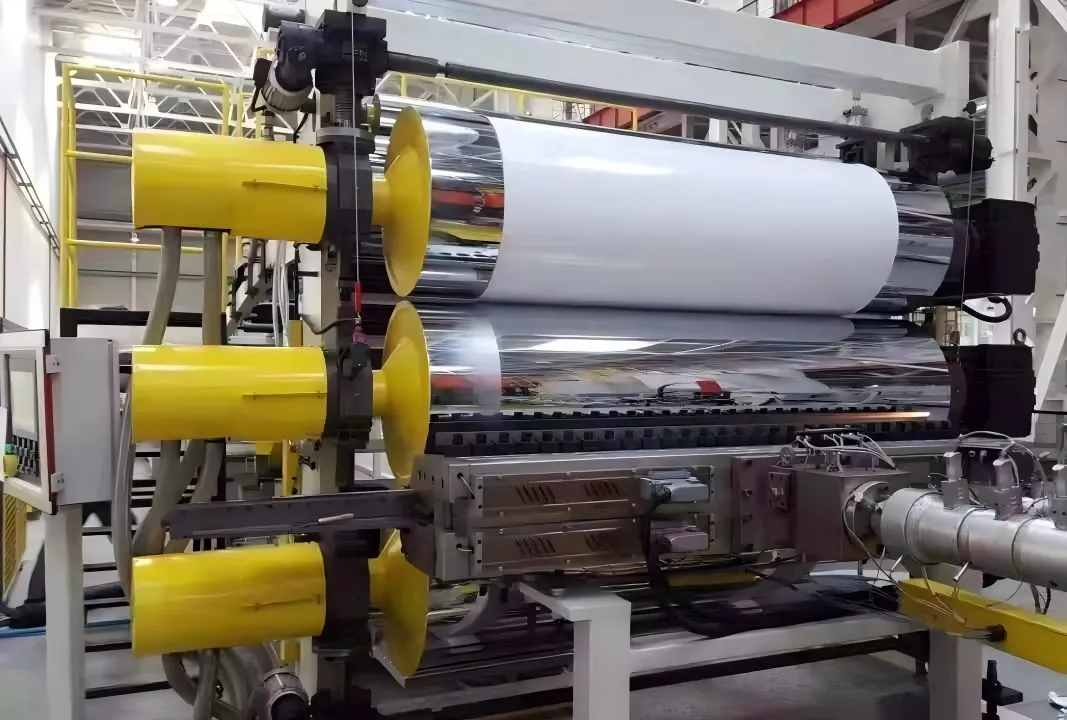
The hot sheet leaving the die is not yet the finished product.
It must pass through the downstream cooling and calendering section, where the material is cooled and stabilized while the required thickness and surface characteristics are established.
The roll system influences:
Sheet thickness
Flatness
Surface appearance
Cooling rate
Line speed
Dimensional stability
The relationship between roll temperature, roll speed, melt temperature, and sheet thickness needs to be controlled carefully.
For rigid PVC, the downstream section is particularly important because a sheet can leave the die with acceptable melt pressure but still develop dimensional or surface problems during cooling.
After cooling, the sheet edges are normally trimmed to achieve the specified finished width.
Edge trimming removes irregular material created near the die edges and provides a clean sheet profile for subsequent processing.
Depending on the final product, the line may then send the material to:
A cutting unit
A stacking system
A winding system for suitable thinner sheet
An inline inspection or measurement system
At this stage, the continuous extrusion process becomes a finished-sheet handling process.
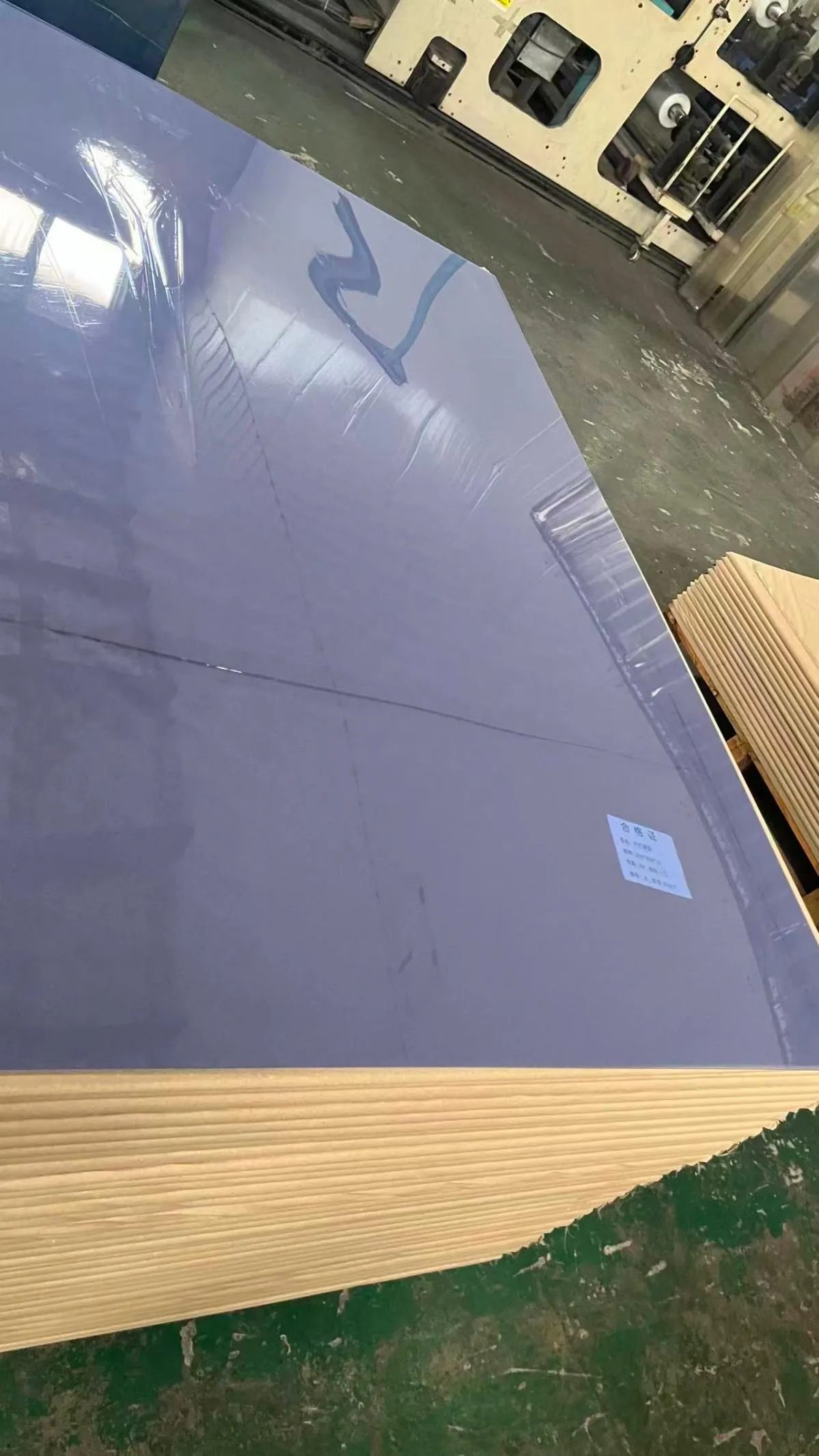
Quality control should not be limited to checking whether the line is producing material.
The finished sheet can be evaluated for:
Thickness uniformity
Width
Flatness
Surface defects
Transparency or color
Impact performance
Dimensional stability
Forming performance
For products where extrusion quality is part of the specification, relevant standards should be identified according to the final application. For example, the current ASTM D3678-26 establishes requirements relating to material properties, dimensional stability, and extrusion quality for rigid PVC interior-profile extrusions.
The standard is not a universal specification for every PVC sheet, but it demonstrates the broader principle that extrusion quality needs to be evaluated against the intended end use.
PVC sheet may be supplied as the final product or used as an intermediate material for forming.
When the sheet is intended for extrusion thermoforming, the extrusion process must produce material with properties compatible with the downstream forming operation.
The connection between extrusion and thermoforming is important because a sheet with inconsistent thickness can heat and deform unevenly during forming.
A practical production chain can therefore be viewed as:
Dry blend → Feeding → Twin-screw extrusion → Plasticization → Flat die → Calendering/cooling → Trimming → Cutting/stacking → Thermoforming
This means the sheet extrusion line should be specified with the final forming process in mind.
The correct machine configuration depends on the intended sheet.
| Parameter | Example Consideration |
|---|---|
| PVC formulation | Transparent, opaque, filled, impact-modified |
| Sheet width | 1,220 mm, 2,000 mm or application-specific |
| Sheet thickness | Thin thermoforming sheet or thicker rigid board |
| Extruder | Twin-screw configuration appropriate for PVC |
| Die | Width and flow distribution matched to sheet |
| Cooling | Roll arrangement matched to thickness and output |
| Downstream | Cutting, stacking, winding, or thermoforming |
| Production target | Capacity, line speed, thickness tolerance |
JWELL's current PVC sheet line page specifically presents different machine configurations according to product width, thickness, motor power, and capacity, demonstrating that the line should be selected around the target product rather than around extruder size alone.
For buyers comparing China PVC rigid sheet extrusion line manufacturers, the evaluation should cover the complete process.
Look at:
Dry-blend compatibility — Can the feeding system handle the intended formulation consistently?
Screw configuration — Is the screw design appropriate for rigid PVC plasticization?
Die capability — Can the die provide the required width and thickness range?
Cooling system — Is the roll section suitable for the target output and sheet thickness?
Automation — Can operators monitor temperature, pressure, speed, and thickness effectively?
Downstream equipment — Does the line integrate cutting, stacking, winding, or thermoforming requirements?
Service capability — Can the supplier support commissioning, troubleshooting, and maintenance?
These factors are more meaningful than comparing the motor power of different sheet extruder companies in isolation.
Not necessarily in the same way as hygroscopic polymers. The more important requirement is that the dry blend is properly formulated, stored, and fed consistently. Processing conditions should follow the specific compound supplier's recommendations.
Twin-screw systems provide controlled conveying, mixing, fusion, and plasticization. They are widely used for PVC formulations because process control is important when working with a thermally sensitive polymer.
Sheet thickness depends on factors including die gap, melt output, line speed, roll conditions, material behavior, and downstream calibration.
A machine may be engineered for multiple materials in some circumstances, but PVC, PE, and PP have different processing requirements. A PE sheet extrusion line should therefore be evaluated according to the intended polymer rather than assumed to be equivalent to a PVC line.
Extrusion produces the sheet, while thermoforming uses heat and forming tools to convert the sheet into a three-dimensional product. When both processes are connected operationally, the extrusion line must produce sheet with properties suitable for the subsequent forming stage.
[2] Teknor Apex – Rigid PVC Dry-Blend Extrusion Processing Guide.
Continue exploring the JWELL sheet extrusion portfolio with these related guides and product references.
Advanced Applications of PVC Rigid Sheet Machine in Modern Manufacturing
ABS Plate Extrusion Machine: A Guide to Plate Extrusion Equipment and Thermoforming
Sheet Extrusion for Thermoforming Material (JWELL Product Page)
This article is prepared by the JWELL sheet extrusion engineering content team, drawing on JWELL’s published product specifications for PC, PMMA, PVC, PET, PE and TPO sheet extrusion lines, plus third-party industry references including ASTM standards, PETCORE Europe technical procedures, Covestro and Röhm material documentation, and Teknor Apex processing guides. Specifications cited (width, thickness, capacity, screw type) reflect JWELL’s published configurations at the time of writing and may vary with specific project requirements.
Last updated: September 2026
Reviewed by: JWELL Sheet Extrusion Engineering Team
Primary sources cited: JWELL product pages (jwell-machinery.com), ASTM International store.astm.org, PETCORE Europe technical library, Covestro Solutions Center, Röhm PMMA application resources, Teknor Apex technical library.