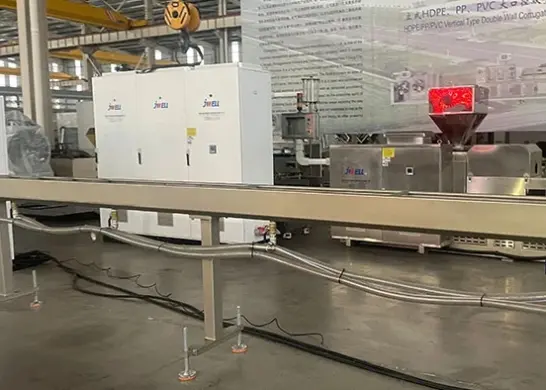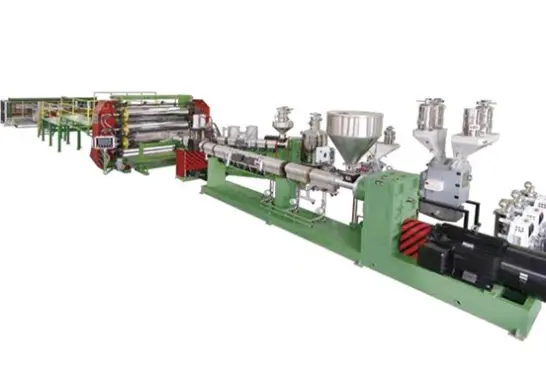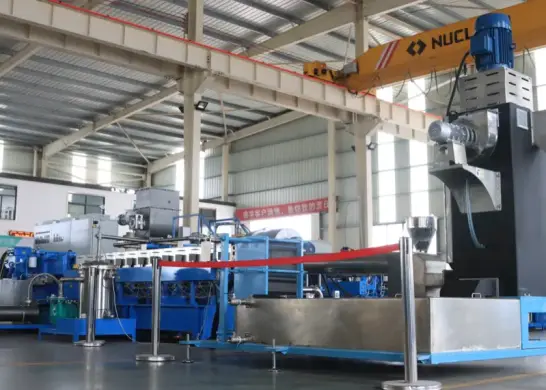
Plastic profiles are widely used in windows, doors, decking, wall panels, decorative components, sealing systems, and construction products. Unlike pipes or sheets, profiles can have highly customized cross-sections designed for specific installation and performance requirements.
A profile extrusion machine provides a continuous method for producing these complex shapes. The process requires precise coordination between the extruder, die, calibration system, cooling section, haul-off, and cutting equipment.
For manufacturers comparing profile extrusion equipment, selecting the machine according to the material, profile geometry, required output, and dimensional tolerances is more important than simply choosing the highest-capacity system. JWELL extrusion machinery includes profile solutions for PVC, WPC, TPU, and TPE applications.
A profile extruder machine continuously melts thermoplastic material and forces it through a specially designed die. The die determines the cross-sectional shape of the finished product.
After extrusion, the hot profile enters a calibration system that establishes its dimensions. Cooling then solidifies the material before a haul-off unit pulls the profile through the line at a controlled speed. Finally, the product is cut, stacked, or otherwise processed.
The basic profile extrusion process includes:
1. Material feeding
2. Plasticization and melting
3. Die forming
4. Calibration
5. Cooling
6. Haul-off
7. Cutting and stacking
Compared with injection molding, extrusion is particularly suitable for long, continuous products with a constant cross-section.
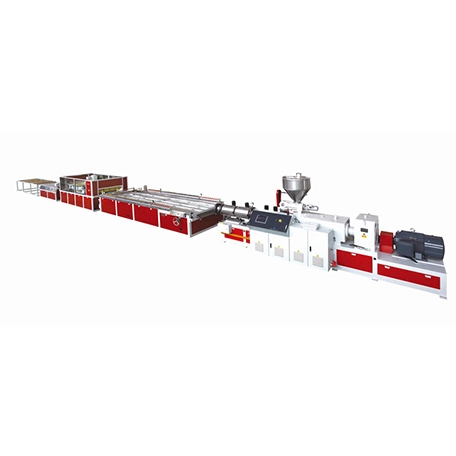
The performance of a profile extrusion line depends on the interaction of several components.
The extruder melts and homogenizes the polymer before it reaches the die. Screw design, temperature control, motor power, and material formulation all influence output and melt quality.
For PVC applications, processing conditions must be matched to the specific PVC formulation. ISO 21306-1:2019 establishes a designation system and basis for specifications for PVC-U molding and extrusion materials, considering properties such as Vicat softening temperature, impact strength, modulus of elasticity, additives, fillers, and intended application.
The die converts the polymer melt into the required profile geometry. Complex window frames, decorative trims, and hollow profiles may require carefully balanced flow channels to achieve consistent dimensions.
Die design is therefore one of the most important elements when purchasing a profile extruder.
Calibration determines the final profile dimensions while cooling solidifies the material. Vacuum calibration tables and cooling tanks are commonly used for products requiring tight dimensional control.
The haul-off pulls the profile continuously through the production line. Its speed must be coordinated with extrusion output to avoid dimensional fluctuations.
After cooling, automatic cutting equipment can produce fixed-length profiles for packaging and downstream assembly.
A pvc window profile extrusion line is designed for profiles used in window and door systems. These products require accurate dimensions because they must fit with glass, hardware, gaskets, and other components during installation.
When selecting a pvc profile extrusion machine, manufacturers should evaluate:
Profile cross-section and dimensions
PVC formulation
Required production speed
Extruder capacity
Die configuration
Calibration accuracy
Cooling capacity
Haul-off stability
Cutting and stacking automation
The objective should be stable production rather than maximum nominal output. A line that maintains consistent dimensions and surface quality can provide greater value over its operating life.
A pvc profile production line can be configured for many products, including window profiles, door panels, decorative trims, skirting boards, and sealing profiles.
Different applications may require different die designs, extruder capacities, calibration systems, and downstream equipment. For example, a hollow window profile has different processing requirements from a solid decorative trim.
Manufacturers should therefore provide detailed profile drawings and material specifications when requesting a machine quotation.
For PVC-U applications, testing and material characterization are also important. ISO 21306-2:2019 – PVC-U Preparation of Test Specimens and Determination of Properties specifies methods for preparing test specimens and determining relevant properties of PVC-U molding and extrusion materials.
Wood-plastic composites combine thermoplastic polymers with wood fibers or flour. Their processing behavior differs from conventional PVC because the formulation contains a significant amount of natural filler.
A wpc profile machine can produce decking, wall panels, fencing, trims, and other continuous WPC products.
Research published through ScienceDirect notes that extrusion is one of the most common forming processes for WPC profiles, including decking, siding, facades, fencing, and other linear products.
This means that a wpc profile production line must address both polymer processing and the characteristics of the wood component.
Wood fibers are sensitive to moisture and excessive processing temperatures. Poor drying can affect bonding and final mechanical performance, while excessive heat can degrade natural fibers.
A recent review of WPC processing also highlights the importance of polymer type, wood content, additives, processing conditions, and extrusion technology in determining final composite performance.
Therefore, material preparation should be considered as part of the extrusion system rather than an independent operation.
PVC and WPC profiles may both be produced continuously, but their processing requirements differ.
Factor | PVC Profile | WPC Profile |
Main material | PVC resin and additives | Thermoplastic + wood filler |
Main challenge | Plasticization and dimensional accuracy | Dispersion, moisture, and thermal control |
Typical products | Windows, doors, trims | Decking, wall panels, fencing |
Die requirement | Complex profile geometry | Profile geometry plus material flow |
Temperature control | Important | Especially critical for wood components |
Surface finish | Smooth or decorative | Wood-like or customized |
Downstream | Cooling, haul-off, cutting | Cooling, haul-off, cutting, finishing |
The material formulation should therefore determine the configuration of the extrusion equipment.
Selecting a profile extruder machine should begin with the finished product.
Provide accurate drawings showing dimensions, wall thickness, hollow sections, tolerances, and critical surfaces. This information is necessary for designing the die and calibration system.
Calculate the required kilograms per hour and production speed according to annual demand and operating hours.
Oversizing a machine can increase investment and energy costs without necessarily improving production economics.
Calibration is particularly important for profiles that must fit with other components. Stable vacuum, cooling, and haul-off conditions can help maintain dimensional consistency.
Modern profile extrusion equipment can integrate temperature control, motor-speed regulation, PLC systems, automatic cutting, and stacking.
Automation can reduce operator intervention and improve repeatability during continuous production.
When comparing extrusion line manufacturers, price should not be the only criterion.
Evaluation Factor | What to Check |
Material expertise | PVC, WPC, TPU, TPE, or other materials |
Die technology | Ability to produce the required cross-section |
Calibration | Dimensional accuracy and stability |
Output | Actual production capacity |
Automation | PLC, cutting, stacking, monitoring |
Energy consumption | Heating, cooling, and drive efficiency |
Technical service | Installation and commissioning |
Spare parts | Availability and delivery time |
A supplier with experience in similar profiles may be better positioned to optimize the complete line.
JWELL extrusion machinery covers multiple extrusion categories, including profile extrusion solutions for PVC, WPC, TPU, and TPE applications.
Its profile equipment portfolio includes PVC window profiles, WPC decking, PVC/TPU/TPE sealing strips, door panels, wall panels, and other customized profiles.
For buyers comparing an extrusion line factory, the advantage of working with a manufacturer offering multiple profile technologies is that equipment can be selected according to the specific material and product structure.
However, buyers should still evaluate each proposed line according to profile drawings, material formulation, output requirements, dimensional tolerances, and actual production targets.
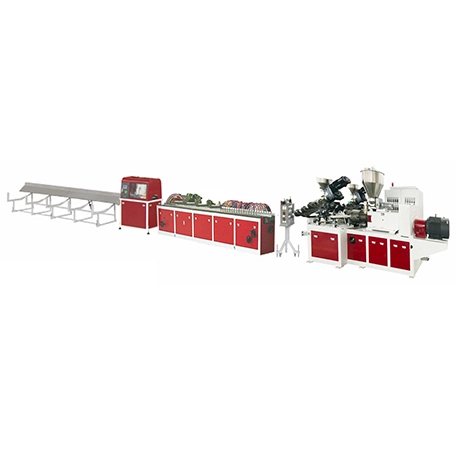
A wpc profile machine is particularly suitable for products where continuous production and wood-like appearance are desired.
Common applications include:
Outdoor decking
Wall cladding
Fencing
Decorative profiles
Architectural trims
Furniture components
WPC extrusion can provide continuous production of both solid and hollow profiles. Research on WPC manufacturing also identifies extrusion as a major process for structural and building-related products.
The final formulation, wood particle size, polymer type, additives, and processing conditions should all be considered when configuring the line.
A profile extrusion machine produces continuous plastic products with customized cross-sections. Typical applications include window frames, door profiles, decking, wall panels, trims, and sealing strips.
A pipe extruder normally produces tubular products, while a profile extruder uses a customized die to manufacture complex cross-sectional shapes.
Depending on its configuration, a profile extruder can process PVC, WPC, PE, PP, TPU, TPE, and other thermoplastic materials.
A pvc profile extrusion line is a complete system that normally includes an extruder, profile die, calibration equipment, cooling section, haul-off, cutting equipment, and stacking or conveying systems.
A wpc profile production line produces continuous wood-plastic composite profiles such as decking, wall panels, fencing, and decorative components.
Compare the supplier's material expertise, die technology, calibration capability, output, automation, project experience, technical support, spare parts, and total operating costs.
A successful profile extrusion line depends on coordinated control of material processing, die forming, calibration, cooling, haul-off, and cutting. The equipment must also match the specific profile geometry and polymer formulation.
For PVC applications, a properly configured pvc profile extrusion machine can provide the dimensional consistency required for windows, doors, trims, and other construction products. For WPC applications, a dedicated wpc profile machine must additionally accommodate the moisture, filler content, and thermal characteristics of wood-polymer formulations.
For manufacturers comparing profile extrusion machine suppliers, JWELL offers a broad range of profile extrusion solutions.
The best equipment decision should therefore be based on the complete production requirement—not simply the machine's nominal output or purchase price. Profile geometry, material formulation, production speed, dimensional tolerance, automation, energy efficiency, and technical support should all be evaluated before selecting the final line.