Filler masterbatch is widely used to modify plastic formulations, reduce material costs, improve dimensional stability, and adjust the surface or processing characteristics of finished products. Producing highly filled masterbatch, however, requires more than simply mixing polymer with mineral powder. The filler must be properly wetted, dispersed, and distributed throughout the carrier resin without causing excessive degradation or equipment wear.
For this reason, manufacturers need carefully configured filler masterbatch extrusion machines and compounding systems. A suitable line must balance feeding, melting, dispersion, degassing, throughput, and pelletizing according to the formulation.
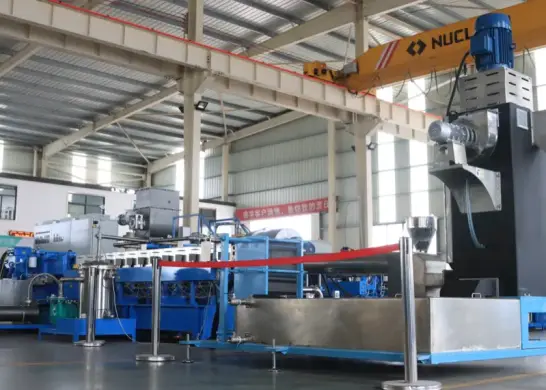
JWELL Machinery provides high-filler compounding solutions based on twin-screw extrusion technology, including equipment for CaCO3, talc, and other highly filled masterbatch formulations.
Filler masterbatch is a concentrated mixture in which inorganic filler is dispersed in a polymer carrier. Common formulations use polyethylene or polypropylene as the carrier, with calcium carbonate, talc, or other mineral fillers.
A filler masterbatch production line typically performs several functions:
1. Feeding polymer and filler materials
2. Melting the carrier resin
3. Wetting and lubricating filler particles
4. Breaking down agglomerates
5. Dispersing filler throughout the polymer
6. Removing moisture and volatile components
7. Extruding and pelletizing the compound
JWELL describes high-filler processing as the dispersion of a high percentage of inorganic powder into a resin matrix. Its process sequence includes polymer melting, filler lubrication, agglomerate dispersion, homogeneous dispersion, homogenization, and degassing.
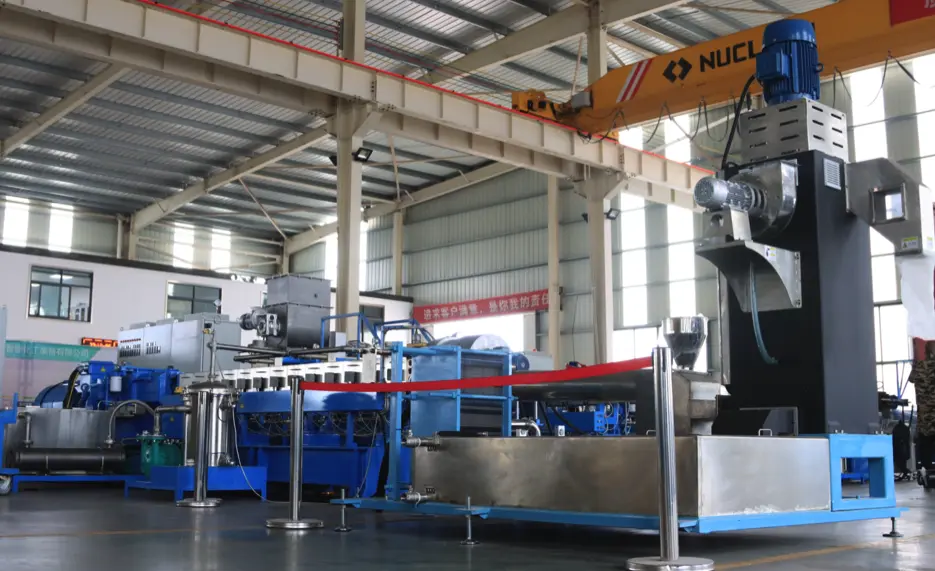
A twin screw extrusion machine is particularly suitable for highly filled formulations because it provides controlled mixing and dispersion along different screw sections.
Research on masterbatch production has also identified co-rotating twin-screw extrusion as a versatile technology for mixing polymer, pigments, powders, and additives.
The screw configuration can be adjusted according to the formulation. Different sections may be designed for conveying, melting, distributive mixing, dispersive mixing, pressure building, and devolatilization.
This flexibility is one reason manufacturers often select a double screw extruder machine instead of a conventional single-screw system for demanding compounding applications.
High filler content increases the amount of powder that must be transported and incorporated into the polymer melt. JWELL notes that deep-flighted screws provide larger free volume and are suitable for highly filled compounds.
The exact screw design should nevertheless be matched to filler percentage, particle characteristics, carrier resin, lubricant system, target output, and required dispersion quality.
Calcium carbonate is one of the most common mineral fillers used in plastics. A filler masterbatch CaCO3 extruder must handle both the high powder loading and the interaction between the filler surface and polymer matrix.
JWELL gives a typical example of PE/PP combined with up to 85% CaCO3 and lubricant for CaCO3-filled masterbatch, while noting that coupling agents may be used to improve compatibility between calcium carbonate and the carrier.
The quality of CaCO3 itself is also important. ISO 3262-6:2022 specifies requirements and test methods for precipitated calcium carbonate.
For natural crystalline calcium carbonate, ISO 3262-5:2023 provides corresponding specifications and test methods.
These material characteristics can affect feeding behavior, dispersion, melt viscosity, equipment wear, and final masterbatch performance.
A complete filler masterbatch extrusion line should be designed around the formulation rather than using the same configuration for every application.
One approach is to premix the polymer, filler, and additives in a high-speed mixer before feeding the mixture into the twin screw extruder.
JWELL explains that premixing can improve powder lubrication and remove moisture through heating, making the mixture easier to feed and potentially supporting higher output. A cooling mixer can then reduce the material temperature before extrusion.
For applications requiring good dispersion and physical properties, premixing through a kneader can provide an alternative route. JWELL notes that kneader premixing can partially plasticize the raw materials, reducing the compounding load placed on the extruder.
This approach can be useful for demanding film filler masterbatch and stone-paper formulations.
Not every twin screw machine is designed for the same production conditions. Buyers should evaluate the machine according to throughput, filler loading, screw diameter, screw speed, L/D ratio, and material characteristics.
Selection Factor | Why It Matters |
Filler percentage | Determines feeding and mixing requirements |
Filler particle size | Influences dispersion and wear |
Carrier resin | Determines melting and processing conditions |
Screw configuration | Controls conveying and mixing |
L/D ratio | Provides space for multiple processing stages |
Screw speed | Influences shear, residence time, and output |
Degassing | Helps remove moisture and volatiles |
Pelletizing system | Determines final pellet shape and production efficiency |
JWELL's published high-filler models include CJWV77 and CJWH95, with listed L/D ranges of 36–56, speeds of 400–900 rpm, and reference capacities of 2,000–3,500 kg/h depending on model.
After compounding, the molten strand must be converted into pellets that can be easily transported, stored, and dosed into downstream plastic-processing equipment.
A CaCO3 filler masterbatch pelletizing line may use strand pelletizing or another suitable pelletizing method depending on formulation, output, pellet dimensions, and cooling requirements.
The pelletizing system should maintain stable strand formation and consistent pellet size without creating excessive fines or irregular particles. For high-throughput production, the pelletizer must also be matched to the extrusion output.
A TPE extruder is designed for processing thermoplastic elastomers, which require different melting and mixing conditions from highly filled PE or PP masterbatch.
However, twin-screw compounding technology can be used across different polymer systems when the screw configuration, temperature profile, feeding system, and downstream equipment are properly adapted.
JWELL's twin-screw portfolio covers high-filler masterbatch, engineering plastics, polyolefin compounding, TPE compounding, PET recycling, and other applications.
Therefore, buyers should select the extruder according to the specific formulation instead of assuming that one machine configuration is suitable for every polymer.
When comparing twin screw extruder machine manufacturers, look beyond the basic machine price.
Important factors include:
Experience with high-filler formulations
Screw and barrel configuration
Filler feeding technology
Wear-resistant components
Degassing capability
Automation and process control
Target production capacity
Pelletizing technology
Installation and commissioning support
Spare-parts availability
JWELL has focused on extrusion equipment and process technology since 1997 and currently offers sheet extrusion, pipe extrusion, compounding, recycling, and other extrusion systems. Its website also lists multiple high-filler masterbatch projects, including a 2023 Portugal project rated at 4,000–5,000 kg/h and a 2025 Egypt project rated at 1,000 kg/h.
This project experience can provide useful reference points when evaluating a filler masterbatch extruder machine supplier.
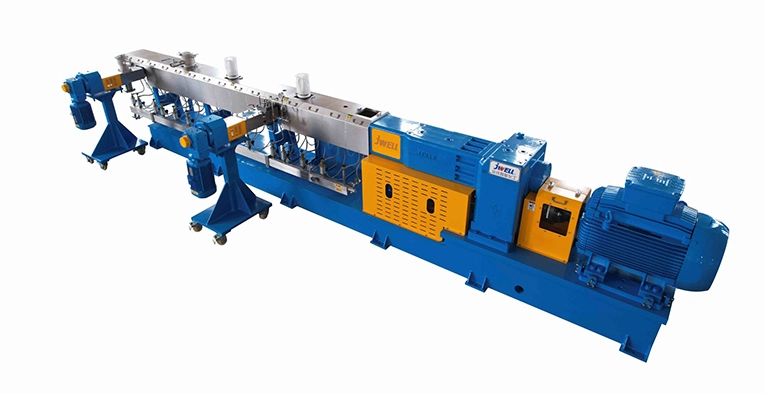
JWELL provides dedicated high-filler extrusion solutions rather than treating masterbatch production as a standard compounding process.
Its High Filler Masterbatch Extrusion Machine portfolio covers PP and PE CaCO3 masterbatch, talc powder masterbatch, and transparent high-filler masterbatch. The company also provides JWELL Twin Screw Extruder solutions for compounding, mixing, devolatilization, and reactive extrusion.
For manufacturers producing highly concentrated filler masterbatch, the combination of appropriate feeding, deep-flight screw geometry, controlled dispersion, and degassing can help create a more stable production process.
A filler masterbatch extruder compounds concentrated mineral fillers with a polymer carrier and produces a homogeneous material that can later be pelletized and used in plastic processing.
A twin screw extruder provides controlled conveying, melting, mixing, dispersion, and degassing. Its modular screw configuration can also be adapted to different formulations.
It is a compounding extruder designed to disperse high concentrations of calcium carbonate into a polymer carrier such as PE or PP. The formulation may also contain lubricants or coupling agents.
Important factors include CaCO3 particle characteristics, filler loading, surface treatment, carrier resin, lubricant system, feeding accuracy, screw configuration, temperature, residence time, and pelletizing conditions.
Yes. With an appropriate configuration, twin-screw systems can process engineering plastics, TPE, polyolefins, recycled polymers, masterbatches, and other compounds.
Start with the formulation and required output. Then evaluate feeding technology, screw design, L/D ratio, filler percentage, degassing, wear resistance, pelletizing, automation, and supplier experience with similar materials.
High-filler masterbatch production requires precise control of powder feeding, polymer melting, wetting, dispersion, degassing, and pelletizing. A properly configured filler masterbatch extrusion machine can help manufacturers achieve high filler loading while maintaining consistent compound quality.
For CaCO3 applications, the filler masterbatch twin screw extrusion line should be selected according to filler characteristics, carrier resin, formulation, target output, and required dispersion. The same principle applies when selecting equipment for TPE and other specialized compounds.
For manufacturers comparing twin screw extruder machine manufacturers, JWELL offers dedicated high-filler solutions alongside a broader range of compounding and polymer-processing equipment.
The most effective purchasing strategy is therefore to evaluate the complete process—from raw-material preparation and feeding through twin-screw compounding and pelletizing—rather than selecting a twin extruder machine based only on nominal capacity.