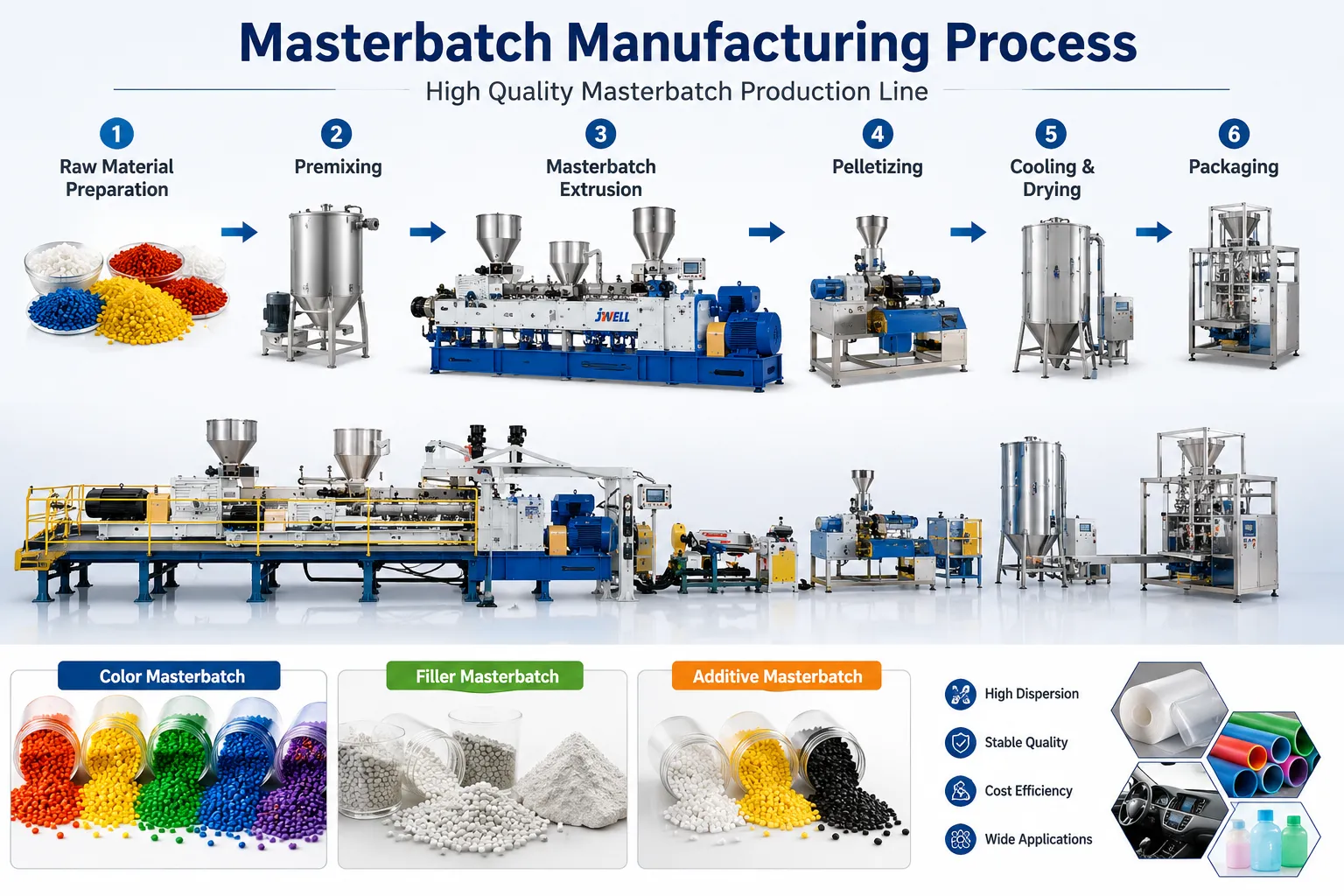
The masterbatch manufacturing process involves blending polymers, pigments, fillers, or additives and processing them through a twin screw extrusion system to create concentrated masterbatch pellets. A complete masterbatch production process includes feeding, mixing, extrusion, pelletizing, cooling, and packaging to ensure consistent quality and optimal dispersion.
Masterbatch is a concentrated mixture of pigments, fillers, or functional additives encapsulated within a polymer carrier resin. These pellets are later mixed with virgin plastic materials to provide color, improve performance, or reduce production costs.
Today, masterbatch production is widely used in packaging, film, pipe, automotive, cable, consumer goods, and engineering plastics industries. Compared with direct powder dosing, masterbatch offers cleaner processing, better dispersion, and more consistent product quality.
The modern masterbatch process consists of several critical stages designed to achieve uniform dispersion and stable pellet quality.
The process begins by selecting carrier resins, pigments, fillers, and additives according to the desired formulation. Common carrier materials include PE, PP, PET, ABS, PA, and TPU.
Raw materials are blended in a high-speed mixer to improve feeding consistency and enhance mixing efficiency during extrusion.
The heart of the masterbatch manufacturing process is the twin screw extruder. During masterbatch extrusion, materials are melted, mixed, dispersed, and homogenized under controlled temperature and pressure conditions.
The co-rotating twin screw extruder ensures that pigments, fillers, and additives are evenly distributed throughout the polymer matrix, resulting in superior product performance.
After extrusion, the molten compound is converted into pellets using water ring, strand, or underwater pelletizing systems.
The pellets are cooled, dried, screened, and packaged before being shipped to plastic processors.
| Stage | Main Function |
|---|---|
| Raw Material Preparation | Formula preparation |
| Premixing | Uniform blending |
| Masterbatch Extrusion | Melting & dispersion |
| Pelletizing | Pellet formation |
| Cooling & Drying | Product stabilization |
| Packaging | Finished product handling |
A color masterbatch extrusion line is specifically designed to disperse pigments into carrier resins while maintaining color consistency and preventing agglomeration.
Modern color masterbatch extruder machines are widely used to produce masterbatch for:
Packaging film
Injection molding
Household products
Automotive components
Consumer goods
High-quality dispersion ensures bright colors, excellent consistency, and improved processing performance.
A filler masterbatch production line is designed for processing high-loading mineral fillers such as calcium carbonate (CaCO₃), talc, and barium sulfate.
Compared with color masterbatch, filler masterbatch requires higher torque and specialized feeding systems due to the large amount of inorganic powder involved.
Benefits include:
Reduced material costs
Improved stiffness
Better dimensional stability
Enhanced production efficiency
These products are commonly used in shopping bags, packaging films, sheets, and pipe manufacturing.
An additive masterbatch production line is used to manufacture functional compounds that enhance plastic performance.
Common additive masterbatches include:
Flame retardant masterbatch
Anti-static masterbatch
UV-resistant masterbatch
Antibacterial masterbatch
Anti-fog masterbatch
Biodegradable additive masterbatch
These products allow manufacturers to add specific functions without changing the primary production process.
In modern masterbatch processing, co-rotating twin screw extruders are considered the industry standard.
Advantages include:
Superior mixing performance
Excellent pigment dispersion
High filler loading capability
Flexible screw configurations
Stable output quality
As a result, most professional masterbatch making machines and masterbatch making machines are based on twin screw extrusion technology.
JWELL Machinery provides complete masterbatch production line solutions for color, filler, and additive masterbatch applications.
Our solutions include:
Color masterbatch extruder machine
Automated feeding systems
Pelletizing and packaging systems
With decades of extrusion experience, JWELL Machinery helps manufacturers achieve higher productivity, better dispersion, and lower operating costs.
The masterbatch manufacturing process involves blending pigments, fillers, or additives with a polymer carrier and processing them through extrusion and pelletizing systems to create concentrated masterbatch pellets.
Color masterbatch is used for coloring plastic products, while filler masterbatch is mainly used to reduce material costs and improve mechanical properties.
Twin screw extruders provide excellent mixing, dispersion, and process flexibility, making them ideal for modern masterbatch production.
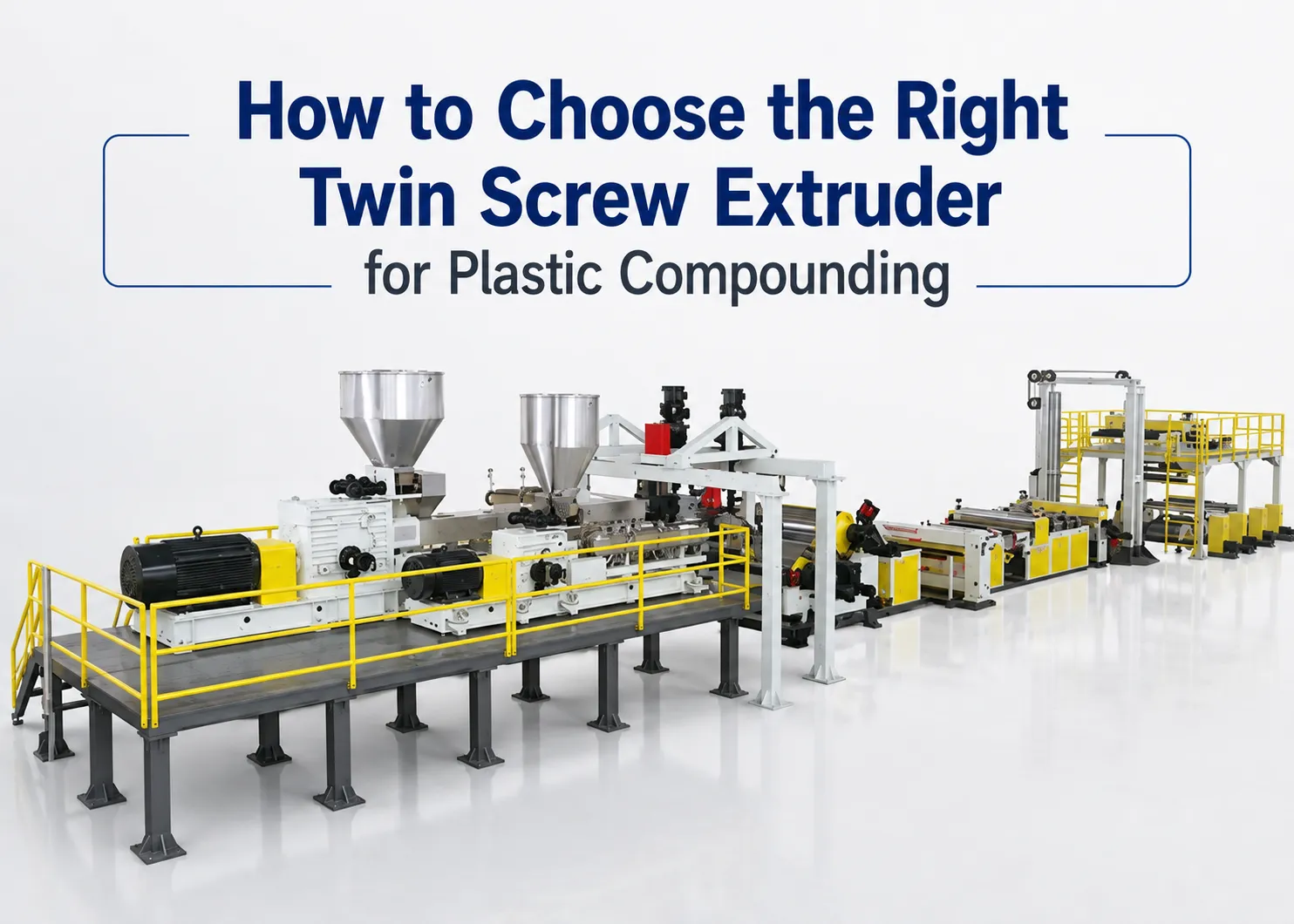
A complete masterbatch production line typically includes feeders, mixers, twin screw extruders, pelletizers, cooling systems, and packaging equipment.