Plastic pipes serve very different purposes, from agricultural irrigation and underground drainage to water supply, cable protection, and industrial applications. As a result, a pipe extrusion machine cannot be selected based on output alone. Pipe structure, material, diameter, wall thickness, production speed, cooling method, and downstream handling all influence the final equipment configuration.
For manufacturers comparing a pipe extrusion line supplier, the key is to match the extrusion system with the actual pipe application. JWELL Machinery offers solutions covering solid pipes, corrugated pipes, special small tubes, and unconventional pipelines, providing a broad platform for different pipe-production requirements.
The pipe extrusion process converts thermoplastic resin into a continuous tubular product. Although individual line configurations vary, the basic stages include material preparation, feeding, plasticization, die forming, cooling, sizing, hauling, and cutting or coiling.
Resin enters the extruder through a controlled feeding system. The screw conveys, melts, and homogenizes the polymer before delivering it to the extrusion die.
JWELL's own process guidance highlights preparation, feeding and drying, extrusion, and plasticization as important parts of pipe production.
The molten polymer leaves the die as a continuous tube. Sizing equipment establishes the required diameter, while vacuum or cooling systems help stabilize the pipe geometry.
Controlled cooling is essential for maintaining dimensional accuracy. The haul-off unit then continuously pulls the pipe through the line at a controlled speed.
Rigid pipes are commonly cut to fixed lengths, while flexible or small-diameter products can be coiled. The downstream configuration should therefore be selected according to the finished product.
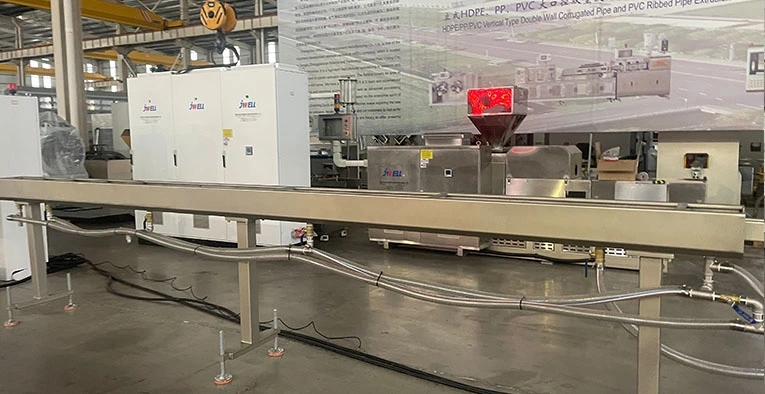
A drip irrigation pipe production line is designed for agricultural applications where consistent water delivery is critical. Compared with conventional solid pipes, drip irrigation products may require specialized forming and in-line processing to create a regular distribution of outlets or emitters.
JWELL lists dedicated drip irrigation solutions within its unconventional pipeline product category. Its portfolio includes different drip irrigation pipe lines alongside aluminum-plastic composite pipes, reinforced thermoplastic pipes, HDPE steel-wire-frame pipes, and large-diameter HDPE hollow-wall coiled pipes.
A round drip irrigation pipe extrusion machine should therefore be evaluated according to pipe diameter, wall thickness, emitter configuration, line speed, raw material, and winding requirements.
For agricultural projects, production consistency matters because variations in pipe geometry or emitter spacing can affect installation and water distribution.
Corrugated pipes are designed differently from smooth-wall pipes. Their structured outer profile can provide flexibility and mechanical performance while reducing material requirements for certain applications.
A corrugated pipe extrusion line normally integrates an extruder with a forming machine, molds or modules, cooling, haul-off, and cutting or coiling equipment.
JWELL offers horizontal and vertical double-wall systems as well as dedicated single-wall solutions. Its single-wall systems are designed for applications including drainage, underground irrigation, highway and railway projects, tunnels, landscaping, and agricultural drainage.
A single wall corrugated pipe machine is generally suited to smaller and flexible corrugated products, while double-wall systems are used where a smooth inner wall and structured outer wall are advantageous.
Feature | Single-Wall Corrugated | Double-Wall Corrugated |
Structure | Corrugated throughout | Smooth inner + corrugated outer |
Typical use | Drainage, irrigation, protection | Drainage, sewage, cable protection |
Flexibility | High | Moderate to high |
Production focus | High-speed forming | Structural performance |
Typical equipment | Compact corrugator | Multi-stage extrusion and forming |
For a single wall corrugated pipe production line, module flexibility and forming speed can be particularly important. JWELL states that some of its mini high-speed systems can produce multiple diameters with the same module, helping reduce module costs.
A corrugated tube extrusion line needs coordinated operation between extrusion and corrugation. Important equipment elements may include:
Single-screw extruder
Extrusion die
Corrugator/forming machine
Cooling system
Haul-off unit
Cutting or winding equipment
Centralized control system
For larger drainage applications, production capacity and forming stability become increasingly important. JWELL's horizontal double-wall corrugated systems cover pipe sizes from smaller diameters through large-diameter applications, with different models offering different speed and power configurations.
International standards can also be useful when defining quality requirements. ISO 21138-1:2020 covers structured-wall PVC-U, PP, and PE piping systems for non-pressure underground drainage and sewerage, including material specifications and performance criteria.
Different pipe materials require different extrusion configurations.
A ppr pipe extruder is commonly used to manufacture polypropylene pipes for hot and cold water systems. Processing stability and temperature control are particularly important because PPR pipe dimensions must remain consistent during extrusion and cooling.
ISO 15874-1 specifies general requirements for polypropylene piping systems used for hot and cold water installations, including application classes, pressure conditions, and test parameters.
Therefore, a ppr pipe extrusion machine should be selected based on pipe specifications, pressure class, material grade, output, and downstream requirements.
An hdpe pipe extruder is typically designed around polyethylene's processing characteristics and the required pipe diameter and pressure rating.
Large-diameter HDPE lines require particularly careful coordination between extrusion output, die design, vacuum sizing, cooling, haul-off, and cutting. JWELL's pipe portfolio includes large-size HDPE solid pipe systems and high-speed HDPE extrusion lines.
A pvc pipe extrusion line manufacturer should be capable of matching equipment to pipe diameter, PVC formulation, wall thickness, and required output.
When comparing pvc pipe extrusion line suppliers, evaluate:
Factor | Why It Matters |
Extruder design | Controls melting and output |
Die and sizing | Determines pipe dimensions |
Cooling | Supports dimensional stability |
Haul-off | Maintains production speed |
Cutting | Controls finished length |
Automation | Improves process consistency |
Technical support | Reduces commissioning risk |
JWELL's pipe extrusion portfolio includes PVC solid pipe lines, two- or four-strand PVC systems, PPR/PERT/PEX lines, HDPE lines, and corrugated pipe equipment.
Not every pipe fits a conventional smooth-wall production line. Specialized products may require additional reinforcement, multilayer structures, coiling systems, or unique forming technologies.
JWELL's Unconventional Pipeline Extrusion Machine portfolio includes drip irrigation pipe lines, PEX-Al-PEX composite pipe lines, high-pressure RTP twisted composite pipe extrusion lines, HDPE steel-wire-frame pipe systems, and large-diameter HDPE hollow-wall coiled pipe lines.
This makes specialized equipment selection especially important when the final product has structural or application-specific requirements.
For structured-wall drainage pipes, ring stiffness can also be an important performance consideration. ISO 9969:2016 specifies a test method for determining the ring stiffness of thermoplastic pipes with circular cross sections.
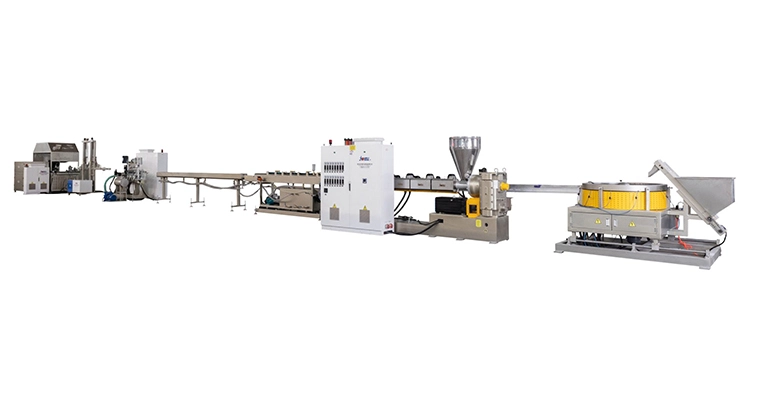
When evaluating pipe extruder suppliers, price should be only one part of the decision. Consider the following:
1. Product range: Can the supplier manufacture equipment for your required pipe type?
2. Output: Does the line meet your target production rate?
3. Material compatibility: Is the system optimized for PE, PVC, PPR, PP, or other polymers?
4. Automation: Can the line provide stable, repeatable production?
5. Project experience: Does the supplier have relevant installations?
6. After-sales support: Are installation, commissioning, training, and spare parts available?
JWELL publishes pipe extrusion projects covering corrugated pipe, PVC, PE, medical tubes, and multilayer pipes. For example, its 2023 Australian four-layer double-wall corrugated pipe project lists a production capacity of 800–900 kg/h.
This type of project information can help buyers assess a supplier beyond basic catalog specifications.
A high productivity PC solid board extrusion line belongs to the sheet and board extrusion category rather than pipe extrusion. PC solid boards are used for applications requiring transparency, impact resistance, and dimensional stability.
JWELL's website separates sheet extrusion and pipe extrusion into distinct equipment categories, with PC sheet and board solutions listed under sheet extrusion.
Therefore, manufacturers considering both pipe and board production should evaluate them as separate extrusion systems rather than assuming that one machine platform can perform both processes.
A pipe extrusion machine melts thermoplastic resin and continuously forms it through a pipe die. Downstream equipment then sizes, cools, hauls, cuts, or coils the finished pipe.
It produces structured pipes for applications such as drainage, irrigation, sewage, cable protection, tunnels, and infrastructure projects.
Single-wall pipe has a corrugated structure throughout, while double-wall pipe generally combines a smooth inner wall with a corrugated outer wall.
Consider pipe diameter, wall thickness, material grade, required pressure class, output, cooling configuration, and applicable standards such as ISO 15874.
Yes. A supplier with a broad product portfolio may provide systems for HDPE, PVC, PPR, corrugated, drip irrigation, and specialized pipes. JWELL's pipe extrusion portfolio covers these different categories.
Check the machine's output, pipe-size range, material compatibility, automation level, energy requirements, installation support, spare parts, and supplier experience with similar projects.
The right pipe extrusion machine depends on the pipe's material, structure, dimensions, application, and required production volume. Drip irrigation, single-wall corrugated, double-wall corrugated, HDPE, PVC, and PPR pipes each require different equipment configurations.
For manufacturers comparing a pipe extrusion line supplier, JWELL offers a broad range of solutions covering standard, corrugated, small-diameter, and unconventional pipeline applications.
By evaluating the complete pipe extrusion process—from feeding and plasticization to forming, cooling, haul-off, and final cutting—manufacturers can select equipment that better matches production goals and product-performance requirements.